Near or far, family travel is a chance to connect, explore, and turn curiosity into discovery. Certain destinations can even extend school study, bringing ancient civilizations and different cultures up close. Here’s our select global guide to places where textbook lessons come to life.
Boston
Best for older grade-schoolers
The Paul Revere Mall
What’s New: Ask AI-supported holographic figures about their experiences during the American Revolution as part of the Museum of African American History’s ongoing exhibit Black Voices of the Revolution, which spotlights the roles of enslaved and free Black men and women in America’s struggle for independence.
What’s New: Coinciding with the 250th anniversary of the United States in 2026, Washington, D.C., is poised for two major openings: the undercroft of the Lincoln Memorial, a behemoth subterranean space including a theatre presentation and interactive exhibits, and the expansive National Geographic Museum of Exploration.
Extra Credit: Marvel at the monuments and memorials lit up at night on a private driving tour—with stops for photos—organized by Four Seasons Hotel Washington, D.C.
Athens
Best for middle school students
The Temple of Poseidon
What’s New: When it opens in 2026, the National Museum of Underwater Antiquities in Piraeus, near Athens, will highlight Greece’s maritime history with more than 2,500 artifacts, including a replica of a trireme.
Extra Credit: Let the team at Four Seasons Astir Palace Hotel Athens take you and your crew on a guided visit to the Temple of Poseidon, at Cape Sounion. It’s sure to be a big hit with Percy Jackson fans.
London
Best for high school students
The Tower of London
What’s New: The Bayeux Tapestry—a depiction of the Norman Conquest of England in 1066, including the critical Battle of Hastings—goes on view at the British Museum in the fall of 2026, on loan from France.
Extra Credit: Explore the Tower of London on a private guided tour arranged by Four Seasons Hotel London at Tower Bridge, seeing the Crown Jewels and learning about imprisonments, executions, and a recent excavation of 14th-century burials that may be tied to the Black Death.
Petra and Amman, Jordan
Best for high school students
The ancient city of Petra
What’s New: Archaeologists continue to make discoveries in the ancient city of Petra; a 2024 dig revealed a 2,000-year-old tomb with 12 skeletons, one of which was holding a ceramic cup, an example of Nabataean pottery.
Extra Credit: Along with guided visits to Petra, Four Seasons Hotel Amman offers such unique experiences as painting at the Roman ruins of Pella.
Kyoto, Japan
Best for middle school students
The Higashiyama district, home to the Kiyomizu-dera Temple
What’s New: Kyoto’s famous Kiyomizu-dera and Toji temples are known for their illuminated night displays. Pair a visit to one of them with an immersive experience at the new teamLab museum Biovortex, where multisensory digital art exhibits include Forest of Resonating Lamps: One Stroke, whose illumination changes in response to human presence.
Extra Credit: Four Seasons Hotel Kyoto offers a host of special tours, which can include visits to the feudal-era Nijō Castle and the Yasaka Pagoda or an after-hours tour of the imperial gardens at Sennyū-ji Temple.
Mexico City
Best for older grade-schoolers
Hot-air balloons over the Teotihuacán pyramids
What’s New: The recently opened Museo Casa Kahlo focuses on iconic artist Frida Kahlo’s early family life, highlighting never-before-seen letters, childhood photos, and clothing, as well as a recently discovered mural. It’s a few blocks from the famed cobalt blue Museo Frida Kahlo, which showcases Kahlo’s artwork and marriage to Diego Rivera.
Extra Credit: Have the team at Four Seasons Hotel Mexico City arrange a private hot-air balloon ride over the spectacular Teotihuacán pyramids, where a major pre-Columbian city once flourished.
It was the first day of our Cantonese food adventures, and my Hong Kong Chinese friends had arranged a lunch in the Nan Yuan (“South Garden” in English), one of the grand old restaurants of Guangzhou, China. We wandered through the colonnaded gardens and halls resplendent in stained glass of many colours to our private dining room, where the feast began beneath a glittering chandelier.
The menu was like a roll call of classic Cantonese cooking. We began with a warming soup brewed from pork stomach and kudzu root (an ingredient in traditional Chinese medicine) that was satiny on the tongue, before the waiter brought in a whole roast goose that had been chopped and then reassembled on the plate, its tender flesh crowned with dark amber skin that was meltingly crisp. Soon, there was sticky, wobbly fish maw, one of the dried seafood delicacies so adored in this region; a whole steamed grouper with glistening flesh; chicken and abalone stewed in a clay pot; stir-fried greens; and, to finish, sticky rice balls stuffed with bird’s nest (a delicacy made from the saliva of swiftlets) in a red bean soup that just murmured of sweetness.
A feast at Lung King Heen at Four Seasons Hotel Hong Kong.
Chef Chan Yan Tak’s Lung King Heen was the first-ever Chinese restaurant in the world to garner three Michelin stars.
Cantonese is one of the world’s most familiar cuisines, yet also one of its least understood. It was the Chinese food first encountered by foreigners in modern times, in the trading enclaves of Macau and Canton (now Guangzhou). It was here, in Guangzhou, that chefs are said to have invented—to suit the tastes of visiting foreigners—the boneless sweet-and-sour pork dish that would become a staple of international Chinese menus. Later, emigrants from the Cantonese-speaking south of China would voyage to America to work the mines and build the railroads, carrying with them the flavours of their homeland.
Cantonese immigrants opened restaurants across America and in many other countries and invented what much of the world would come to know as Chinese food. It was a formula rooted in Cantonese tradition but heavily adapted to Western palates: tasty, inexpensive, and devoid of awkward bones and wobbly textures. Instead of steamed fish, vibrant vegetables, and gentle soups, there were fried noodles and boneless meats. This hybrid cuisine was to become wildly popular but also the victim of its own success. Outside of China, Chinese cooking, so diverse and complex, was rarely considered to be sophisticated. Instead, it was branded as cheap, lowbrow, and unhealthy.
It’s one of the great ironies of history that China’s great gastronomic culture, along with one of its most esteemed regional traditions, should be so underestimated. Within China, Cantonese is regarded as one of the country’s Four Great Cuisines, along with those of Sichuan, Shandong, and the Jiangnan region around Shanghai. Although you wouldn’t guess it from the deep-fried tidbits and sweet-sour flavours that characterize Chinese food abroad, Cantonese cooks are renowned for their insistence on fresh ingredients, their light touch with seasonings, and their precise command of heat and timing.
Artful delicacies at Yu Yue Heen at Four Seasons Hotel Guangzhou.
“Cantonese food is all about the essential tastes of ingredients,” says chef Yongsheng Li of the Michelin-starred Yu Yue Heen restaurant at Four Seasons Hotel Guangzhou. “With a fine steamed fish, we might season it with nothing but oil and salt because we don’t want to cover up its natural flavour. And we insist on eating foods in their proper seasons: lamb in winter, for example, toon shoots [from the Chinese mahogany tree] and other sprouting vegetables in spring.” Soups, made with ingredients designed to maintain health in every season, have a particularly important role in local meals.
One of the most representative local dishes, says Li, is white cut chicken. “The key to this dish is to choose the right breed and age of chicken and cook it within hours of slaughter,” he says. Like many Cantonese dishes, it appears plain but is technically complex: the bird must be poached at a carefully controlled temperature, like an artisanal sous vide, resulting in taut skin and flesh that is brisk but juicy, with a little pinkness in the bones.
The flavours of Cantonese cuisine are more discreet than, say, the fire and spice of Sichuan. Ginger, spring onions, and aged tangerine peel are favoured seasonings, along with soy sauce and black fermented soybeans. Certain cooking methods and culinary creations are regarded as quintessentially Cantonese: the delicate steaming of seafood; fastidious roasting techniques that give pork and poultry tempting aromas and crisp textures; translucent shrimp dumplings and a whole gamut of delicate dim sum. There are flash stir-fries imbued with wok hei (“the breath of the wok”); nourishing desserts that often take the form of soups; and hearty claypot dishes. Cantonese eaters take particular delight in the textures of their foods, which is why they enjoy so many ingredients that can perplex foreigners, like slippery-crunchy jellyfish.
The Chairman chefs, including Danny Yip, at center.
Sticky rice pairing steamed crab with tiny pink shrimp at the Chairman.
Cantonese food itself is diverse and wide-ranging. In Guangzhou, you could spend days exploring dim sum alone, popping into a tiny café that serves fresh cheung fun (noodle rolls made with steamed sheets of rice pasta) or brunching on dozens of dumplings in the gorgeous Tao Tao Ju restaurant in the heart of the old town. You might lap up some turtle broth from a blue-and-white china pot at Dayang, a hole-in-the-wall conspicuous for its towers of steamers, each layer filled with pots of a different kind of soup. At the other end of the social scale, you could spend a fortune on abalone and other prized delicacies. (And if you’d like a taste of the origins of Westernized Chinese food, you could go to the Guangzhou Restaurant for what they call their “nostalgic” sweet-and-sour pork with chunks of pineapple.)
Any local gourmet can tell you that Cantonese isn’t even a single cuisine. It encompasses not just the rich gastronomic traditions of Guangzhou, the provincial capital, but also the distinctive foods of Shunde, known for its unusual dairy foods made from buffalo milk, and of the Chiu Chow region in the east, with its extravagant seafood, hearty peasant stews, and desserts such as sweet, lardy taro porridge. Another element is the rustic tradition of the Hakka people, whose classic dishes include stuffed tofu and pork belly steamed with salty vegetable preserves. And in Hong Kong, with its wealth and cosmopolitanism, Cantonese food mixes with the flavours of the world.
For many years, Chinese food of any kind was neglected by the international arbiters of taste. Until the end of the 20th century, China itself was largely off the international travel map, and most Chinese restaurants abroad were of the cheap-and-cheerful variety.
“Foreigners misunderstand Cantonese cuisine because they only encounter the basic stuff and never have the chance to taste more elevated versions,” says veteran Hong Kong food writer and restaurateur Lau Kin-wai. “Most Chinese restaurants abroad just serve Chinese food as it exists in foreigners’ imaginations.”
The appetizer plate at Michelin-starred Zi Yat Heen at Four Seasons Hotel Macao. “We imagine Cantonese classics with finesse, accenting them with global luxuries,” says Chef Anthony Ho.
Over the last couple of decades, the outside world has begun to wake up to the possibilities of Chinese food. Increased travel and emigration by people from many parts of China (not just from the Cantonese south) have spurred the development of a more authentic Chinese dining scene in Western cities. Sichuan cuisine has exploded in global popularity, shattering the idea of Chinese as a monolithic food culture, while the flavours of northern Xi’an, spicy Hunan, and the Shanghai region have also begun to attract attention. And China’s rise in wealth and power on the international stage is inevitably starting to raise the status of Chinese food and culture more generally.
In 2009, Michelin for the first time awarded three stars to a Chinese restaurant, Lung King Heen at Four Seasons Hotel Hong Kong, which was then, as now, under the stewardship of veteran chef Chan Yan Tak. It was a belated acknowledgment that Chinese food could be both fine and expensive, and a seismic moment for a restaurant specializing in classic Cantonese cuisine. “I was taken aback, but also honoured by the recognition,” says Tak. The restaurant’s specialities include Superior Pottage, a rich, nutritious soup that distills the flavour essences of lean pork, Yunnan ham, and fine local chickens. This local delicacy is light-years away from the kind of food served in American Chinese diners.
The same year, 2009, another Cantonese restaurant, the Chairman, opened in a quiet backstreet in Hong Kong and began to make waves. While living in Australia, its owner, Danny Yip, had been infuriated with the lowly reputation of Chinese food. After returning to his native Hong Kong, he decided to take a fresh look at traditional Cantonese food and produce “a fine version of home cooking.” He and his team applied themselves to reinventing humble dishes, like congee and claypot rice, using premium ingredients and spending months developing individual recipes, such as their now-classic steamed flowery crab with Shaoxing wine. In 2021, the Chairman was the first Chinese restaurant to top the annual list of Asia’s 50 Best Restaurants.
The spotlight brought by these international accolades has opened the door to greater global recognition of Chinese cuisine. It has also helped to give other Cantonese chefs the confidence to take a fresh look at their traditions. After all, Cantonese food is in many ways perfectly suited to contemporary tastes and trends, with its emphasis on lightness and balance and its attention to fine, seasonal ingredients.
“I knew I would combine French technique with local ingredients,” says Wing chef Vicky Cheng.Braised abalone prepared with goose feet and shitake mushrooms at Zhuo Yue Xuan at Four Seasons Hotel Shenzhen.
One chef who is helping to reshape perceptions of Chinese food is Vicky Cheng. Although Hong Kong born, he grew up in Canada, where his ambition was to become a famous French-trained chef because, he says, “I always believed French cuisine was the epitome of fine dining.” After years spent working in French kitchens, he realized, he says, that there was an essential contradiction in his life, because “I was craving Asian food every day.” So, he returned to Hong Kong for exposure to Asian flavours. His first restaurant, VEA, presented a fusion of his French and Chinese influences, and then in 2021, he opened Wing, a new kind of Chinese restaurant.
“In the beginning, I knew nothing about Cantonese food because all my training had been French,” he says. He applied himself to studying the local culinary arts through a process of trial and error: in particular, he wanted to master dried seafood delicacies, such as sea cucumber and fish maw. “I knew I would combine French technique with local ingredients and felt that if I was going to tackle a fine dining approach, I needed to conquer these important delicacies, the Chinese equivalents of French caviar and truffles.” Now, he says, he cooks in a “boundaryless” way, without the baggage of traditional rules.
Affluent Hong Kong Cantonese may be the world’s most discerning diners, well versed in both Chinese and international cuisines, and Cheng’s novel approach faced a certain amount of initial skepticism. A few years in, he has converted many of his critics, while his eclectic cooking seems perfectly suited to a culinary region that has long been China’s window onto the world. In 2025, Wing is in third position on the Asia’s 50 Best list.
“We are just so happy that we are now on the international map, bringing the attention of the international crowd to Chinese food,” says Cheng. “And I hope this recognition on the world stage is just the beginning, not just for myself but for Chinese cuisine.”
What will we covet next? A who-what-where report from the frontlines of luxury fashion, design, dining, and more.
01
THE SUMMIT OF EXCLUSIVITY: Limited-edition lines, such as Louis Vuitton’s Objets Nomades home and furniture collection, represent an increasing focus for high-end brands. With worldwide distribution more available than ever for a maison’s main lines, it’s no longer enough for price to confer exclusivity. Luxury houses dream up extra offerings characterized more by scarcity and whimsy than by simple cost. A standout from the 2025 Objets Nomades roster is the Kaleidoscope Cabinet (pictured below, left), produced with Brazil-based Estúdio Campana. More than two years of development went into the creation of this exquisite limited edition (there are only eight)—with time spent on everything from the gold-plated brass hinges to the curved bottom drawer. (The drawer was so difficult to achieve, it almost stymied the entire concept.) —Mark Ellwood
02
FASHION RESET: A changing of the guard electrified the runways for the Spring 2026 season. In Milan, Dario Vitale’s first solo outing for Versace mixed bold colours with slim cuts evocative of Gianni’s 1990s heyday, while at Gucci, Demna’s tribute to the label’s iconic motifs included maximalist interpretations of the horse bit and the GG monogram. From Paris, highlights included Jonathan Anderson’s modern take on the New Look at Dior; Pierpaolo Piccioli’s sculptural designs in a “neo gazar” fabric at Balenciaga; Michael Rider’s blend of French minimalism and preppy chic at Celine; and technicolour-bright pieces, inspired by an Ellsworth Kelly painting, from Loewe designers Jack McCollough and Lazaro Hernandez (the founders of Proenza Schouler). But few designers stirred more anticipation than did Matthieu Blazy, formerly of Bottega Veneta, with his debut collection for Chanel. On a runway themed to Coco Chanel’s love of astronomy, Blazy offered his interpretations of the house’s iconic codes, from menswear influences to textural tweeds and colourful feathers (see photo above). The overriding idea? Said Blazy, “I just wanted to have fun.” —Laurie Brookins
03
SENSE OF PLACE: Since its 2023 debut on the World’s 50 Best Restaurants list at number 37, Sézanne at Four Seasons Hotel Tokyo at Marunouchi has continued its rise. In 2025, it rocketed to the list’s number-seven spot; it also holds three Michelin stars. Under chef Daniel Calvert’s direction, Sézanne is celebrated for its 12-course tasting menu highlighting seasonal Japanese ingredients. Calvert credits the restaurant’s success to an unwavering pursuit of excellence: “That’s what you strive to do—a little better every day.” —Degen Pener
04
ICONIC CHARMS: Grace Kelly and Elizabeth Taylor were photographed in the 1970s wearing Alhambra—the famed collection that Van Cleef & Arpels debuted in 1968—but today, as men increasingly embrace luxury jewelry, it might be NBA legend LeBron James, Olympic fencer Cheung Ka Long, or the Los Angeles Dodgers’ Miguel Rojas sporting the striking four-leaf-clover designs (tiger’s-eye style shown). The newest Alhambra examples showcase clovers of blue agate, while others include onyx, historically a talisman against negative energy. —L.B.
1: The new Kaleidoscope Cabinet from Louis Vuitton’s Objets Nomades collection.
3: Morel mushrooms with white asparagus and roasted chicken sauce at Sézanne.
05
PERFECTLY POISED IN LONDON: Understated. Discreet. Refined. Four Seasons Hotel London at Park Lane exemplifies this era’s embrace of quiet luxury. The original Four Seasons in Europe, the London hotel celebrated its 55th anniversary in 2025 by earning three Michelin keys for the second year in a row, while its Yannick Alléno–helmed restaurant Pavyllon London retained its Michelin-star honour. A collection of 18 recently renovated suites (some with terraces overlooking Hyde Park) feels like a sanctuary in the city, as does the spa, which offers treatments and wellness therapies ranging from a jet-lag massage and body brushing ritual to a holistic facial based on Chinese medicine techniques. The property shares its three-Michelin-keys distinction with its Four Seasons sister hotels in Megève, France; Athens (Astir Palace); Tokyo (Otemachi); and Paris (George V). —Pavia Rosati
06
AI HYPERCAR: In a sign of how artificial intelligence is entering the luxury auto world, the start-up Vittori unveiled its first hypercar, the Turbio, in October. Designed with the famed Italian firm Pininfarina, the vehicle features a sleek and sculptural silhouette derived from hundreds of AI-generated concept renders, and AI-powered 3D printing methods influenced the shape of the carbon-fiber and titanium chassis. Only 50 models will be made, produced in collaboration with Pininfarina. —D.P.
07
BRITISH WINE WINS: The bubble’s popped: French sparkling wine no longer retains its stranglehold after a series of upstart wineries bested Champagne’s finest at several contests—and those triumphant vintages are from England, where the terroir mirrors that of Épernay but the climate retains the crispness essential to superb fizz. Specifically, it was Nyetimber’s 2016 Blanc de Blancs Magnum that pipped four shortlisted candidates for the crown at the International Wine Challenge awards in September, the first time a wine from outside of Champagne has taken the title. Order a bottle or two of Nyetimber at Four Seasons Hotel Tokyo at Otemachi. —M.E.
08
EAR CANDY: In a sea of on-the-go audio options, Bang & Olufsen’s Beo Grace wireless earbuds stand apart for their chic refinement and world-class sound quality. The striking earbuds with polished aluminum stems are remarkably lightweight—enough that each earpiece can rest on a flower petal. Even the pearl-blasted aluminum charging case is elegant and can stylishly sit on a valet tray when not in use. —Beau Hayhoe
5: Four Seasons Hotel London at Park Lane celebrated its 55th anniversary last year.
09
VINYL RENAISSANCE: Vinyl has serious staying power, as seen in the number of listening bars opening worldwide. To get that hi-fi, high-design experience at home, look to Wrensilva’s meticulously engineered record consoles, available in a variety of wood finishes, each one a statement piece. The San Diego–based company’s latest offering is the Wrensilva Larrabee Creator Edition M1 console, a limited-edition collaboration with the Grammy-winning mix engineer and Larrabee Studios owner Manny Marroquin. Built to integrate with Sonos audio systems, the console is a study in both striking good looks and remarkable sound quality. —B.H.
10
ULTRA PERSONALIZED: No other fashion company in the world is quite like NB44. Founded by Nicolas Bijan Pakzad, the invite-only, membership-based brand takes the personalization of luxury to the next level: Each quarter, it sends a custom-built trunk (pictured below, left) of its stylish menswear to its clients, who include Wicked director Jon Chu, with each delivery tailored to the wearer’s lifestyle. Clients can purchase what they like and request any changes they desire, such as remaking a burgundy zip-neck sweater in navy with a shawl collar. —B.H.
11
HANDPICKED FOR HOME: If, like most style obsessives, you’re still mourning the demise of MatchesFashion.com, fret not: co-founder Tom Chapman, with his signature edgy, eclectic eye, is now running Abask, an online outlet specializing in home and design. The site epitomizes the search for exclusivity that remains a core driver for luxury. It features 2,000 or more handpicked treats, both antique and contemporary, as well as its own reissues of design classics from the likes of NasonMoretti, the Murano-based glassworks. This season’s particular focus: Japanese makers. Take your pick between Kyoto-based Seikado, renowned for exquisite pewter for almost 200 years; Kagawa-based Mori Glass, including the studio’s striped tumblers (pictured below); and the Tokyo-based contemporary home line Thursday Furniture, among others. —M.E.
12
EFFERVESCENT AND LOW ALCOHOL: Move over Aperol. There’s another spritz in town. And in 2025, it took over the world. The Hugo Spritz is an invigorating form of floral refreshment born of the Italian Alps—an assemblage of St-Germain elderflower liqueur, Prosecco, fresh mint, lime, and soda. Though it was initially conceived 20 years ago, the Hugo is surging in popularity now, thanks in part to today’s no- and low-alcohol movement (see “Zero Proof, Full Flavour”). The ginger-tinted drink retains body and flavour while having half the alcohol content of a typical martini. —Brad Japhe
10: NB44’s special delivery: a custom-built trunk packed with a new seasonal wardrobe for the client.
11: Striped Mori Glass tumblers at Abask.
13
SUNNY DIAMONDS: The ubiquity of lab-grown diamonds has had a ripple effect on the fine-jewelry industry: Retailers are seeing rising interest in natural coloured diamonds that stand out among look-alike icy white cultured stones. In-demand hues include warm whites, ambers, and yellows—the last a favourite and a focal point of the new Talk to Me, Harry Winston collection. Among the pieces from this series is a ring highlighting a 5.02-carat, pear-shaped yellow diamond, as well as 26 pear-shaped and round brilliant diamonds, set in 18-karat yellow gold and platinum. The message is clear: in a market flooded with sameness, rarity and uniqueness still rule. —Victoria Gomelsky
14
SPLENDOUR IN SPAIN: In 2025, Four Seasons garnered the most property rankings on the latest World’s 50 Best Hotels list, which also named the company the “most admired hotel group” in the world. A remarkable seven Four Seasons properties were lauded across the full list (with extended rankings 51 to 100), including Four Seasons Hotel Madrid. Opened in 2020 as part of the Centro Canalejas Madrid complex, the hotel stands in the heart of Madrid’s historic city centre—now revitalized with galleries, boutiques, and cafés—and serves as a beacon of the neighbourhood’s transformation. On the seventh-floor roof terrace sits Dani Brasserie, where Michelin-starred dishes by chef Dani García mix Spanish and Andalusian flavours, and visitors and Madrileños alike take in the panoramic views, appreciating the city’s past and present. —Julie Pham
15
KNITTED AND FITTED: Nothing says “quiet luxury” quite like chic knitwear, be it cashmere or a fine merino wool. And few names in the space do knitwear better than N. Peal, established as a men’s haberdashery in London in 1936. In 2025, the brand teamed up with actor and travel-show host Stanley Tucci for a capsule collection of irresistible pieces, from cashmere quarter-zips and superfine silk-blend polos to cashmere-and-silk bird’s-eye jacquard ties. —Tres Dean
16
THE ARTISANAL DIFFERENCE: In 2018, Johann Rupert, the chairman of Richemont, co-founded the nonprofit Michelangelo Foundation with an express mission: to champion craftsmanship of all kinds. Makers were to be celebrated, and their skills propagated. So, the foundation launched Homo Faber—a pop-up exhibition, held regularly in cities like Venice and Seville, that showcases artisan works. Now, it’s offering an always-on option: a series of handy craftsmanship-oriented guides to different cities on the Homo Faber website. The 11-stop itinerary for Florence, for example, features everything from the perfumer Aquaflor to the workshop of Daniele and Letizia Traversari, fourth-generation mosaic makers with a particular aptitude for portraiture. —M.E.
15: Stanley Tucci wearing pieces from his capsule collection for N. Peal.
17
MECHANICAL LEAP: Ahead of 2025’s Watches and Wonders fair in Geneva, speculation about Rolex’s upcoming debut buzzed across social media. When the company officially revealed the Rolex Land-Dweller—its first entirely new model since 2012—the excitement proved justified. The watch features a slim, vintage-inspired case paired with an integrated flat-link bracelet, marking a fresh aesthetic direction. More important, the timepiece holds Rolex’s groundbreaking Dynapulse escapement, a new mechanism that governs the transfer of energy from the mainspring to the hands. Watch insiders have praised the robust and efficient movement as a game-changer precisely because it reaffirms that mechanical innovation can be pushed to new heights. “An accomplishment like this happens every couple hundred years,” says Paul Boutros, the head of watches for the Americas at the auctioneer Phillips. “It’s revolutionary.” —V.G.
18
CULTIVATING EDEN: Through his five-year-old lifestyle brand Flamingo Estate, former advertising executive Richard Christiansen has somehow made regenerative agriculture downright glamourous. In 2025, he took it to new heights. Think collaborations with chefs such as Alice Waters and Evan Funke to guest-curate Flamingo Estate’s coveted produce boxes; limited-edition jars of pickles dreamed up with Pamela Anderson; and a steady stream of swoon-worthy skincare, soaps, and standout candles like the decadent Prinsesstårta (pictured below, left), inspired by San Ambroeus’ iconic Principessa cake. Nestled in the hills of Los Angeles, Flamingo Estate crafts everything using organic ingredients grown at more than 140 regenerative farms—proving that sustainability can, in fact, smell amazing. —D.P.
19
PICKED AT THE PEAK: Amid all the tweezer-y ornamentation and pageantry of fine dining, there is ultimately nothing more luxurious than a piece of perfectly ripe fruit. Consider Tomat, a Los Angeles farm-to-table restaurant near LAX, where the most succulent thing on chef Harry Posner’s menu might be a pastel green slice of arava melon, harvested at Weiser Family Farms, that he caps with a few pieces of white strawberry kimchi and droplets of sesame oil. At Ki, in L.A.’s Little Tokyo neighbourhood, chef Ki Kim occasionally winds down his Michelin-starred Korean tasting menu by slicing up a ripe and just-right summer peach and dusting it with lime zest. “When the fruit itself tastes that good,” Kim says, “there’s no need for much else.” —Jeff Gordinier
20
CARRY THE DAY: Fashion is offering an alternative to the quotidian canvas tote, something a little more luxurious: the leather tote as an everyday carryall. The bag of the moment? Superstar designer Willy Chavarria’s signature, genderless W Tote bearing a bold “W” topstitched across its front and back panels. —T.D.
18: Flamingo Estate’s Prinsesstårta candle, inspired by San Ambroeus’ iconic Principessa cake.22: Marc Jacobs at his pop-up with artist Anna Weyant at New York Fashion Week. Photograph by BFA.
21
THE NEW GILDED AGE: Gold, if you haven’t noticed, is on a tear. In October, the precious metal’s price topped $4,000 an ounce for the first time. While the rising cost of the material has rattled the fine-jewelry industry, consumers appear undeterred and are leaning even harder into gold despite—or perhaps because of—its soaring value. Pieces of the moment include David Yurman’s 18-karat gold Sculpted Cable bangle bracelet. —V.G.
22
ALL THINGS GREAT AND SMALL: Perhaps Goldilocks was wrong when she settled for that just-right-sized bed. Across design culture today, a rule-breaking focus on playing with proportion is afoot, from the goofily gigantic to the endearingly Lilliputian. In the latter camp, several British makers offer custom miniatures of iconic architecture, from Mulvany & Rogers to Chisel & Mouse, which recently released a mini Thomas Jefferson Memorial to coincide with the 250th anniversary of the United States in 2026. In September, zeitgeist-surfer Marc Jacobs partnered with white-hot artist Anna Weyant for a pop-up installation during New York Fashion Week, where the pair created a life-size, dollhouse-like landscape. Visitors could meander through, enjoying such outré details as an oversize two-headed teddy bear. —M.E.
23
LUMINOUS INNOVATION: Sweet Chemistry and Knesko are redefining skincare with distinct, science-backed approaches. Sweet Chemistry face products feature the brand’s proprietary Matrikynes complex, a mix of bioactive peptides found in upcycled bovine bones, to boost skin density and hydration and reduce fine lines. Meanwhile, GemClinical Technology infuses gemstone particles into Knesko’s decadent treatments to stabilize active ingredients like CoQ10 and vitamin C and to help activate the body’s chakras, or energy centers. The Knesko collection includes the Diamond Radiance Collagen Face Mask, which is used in the signature facial at the Beverly Hills Spa at Beverly Wilshire, Beverly Hills, A Four Seasons Hotel. —Elycia Rubin
24
EPICUREAN EXCELLENCE: The same year that French haute cuisine was crowned the best in the world at the biennial Bocuse D’Or chef competition (in 2025), two redoubts of haute gastronomie retained their three-Michelin-star rankings: Le Cinq at Four Seasons Hotel George V, Paris, and Caprice at Four Seasons Hotel Hong Kong. At Caprice—a temple of opulence with dazzling Czech crystal chandeliers, a glass catwalk, and stunning views of Victoria Harbour—the central open kitchen is where the culinary magic happens, with chef Guillaume Galliot and team leaning into luxurious ingredients; think blue lobster from Brittany, Alaskan king crab, and Japanese Saga beef. The wine list is extensive, as is the selection of cheeses at Caprice Bar. —Nicola Chilton
25
LIQUID ARTISTRY: In 2025, three establishments at Four Seasons were honoured by the World’s Best 50 Bars list: Virtù at Four Seasons Hotel Tokyo at Otemachi (renowned for the use of Japanese produce with French spirits); Argo at Four Seasons Hotel Hong Kong (noted for its innovative ingredients); and BKK Social Club at Four Seasons Hotel Bangkok at Chao Phraya River, which excels not just because the drinks are outstanding but also thanks to storytelling. BKK Social Club’s latest narrative-driven menu takes inspiration from all things Mexico, with creations like the Frida Kahlo (with Michter’s Bourbon, lavender-infused maple syrup, and coconut) and the Lucha Libre (a Michelada-style highball). “Each drink tells a part of Mexico’s story,” says Philip Bischoff, beverage manager at the Bangkok hotel (which the 2025 World’s 50 Best Hotels list named the second best on the planet). —Vincent Vichit-Vadakan
Art isn’t restricted to that which is painted, contained within a frame, and hung on the walls of a grand museum like the MET in New York City or the Louvre in Paris. Art can be an exquisitely designed dress, for instance, and it can be found anywhere—in the desert, on a beach, in an eyeglass shop, even. Here are four new exhibitions of beyond-the-frame art that are on our radar.
Florence, Italy
A thoroughly modern interpretation. Photograph by Ela Bialkowska.
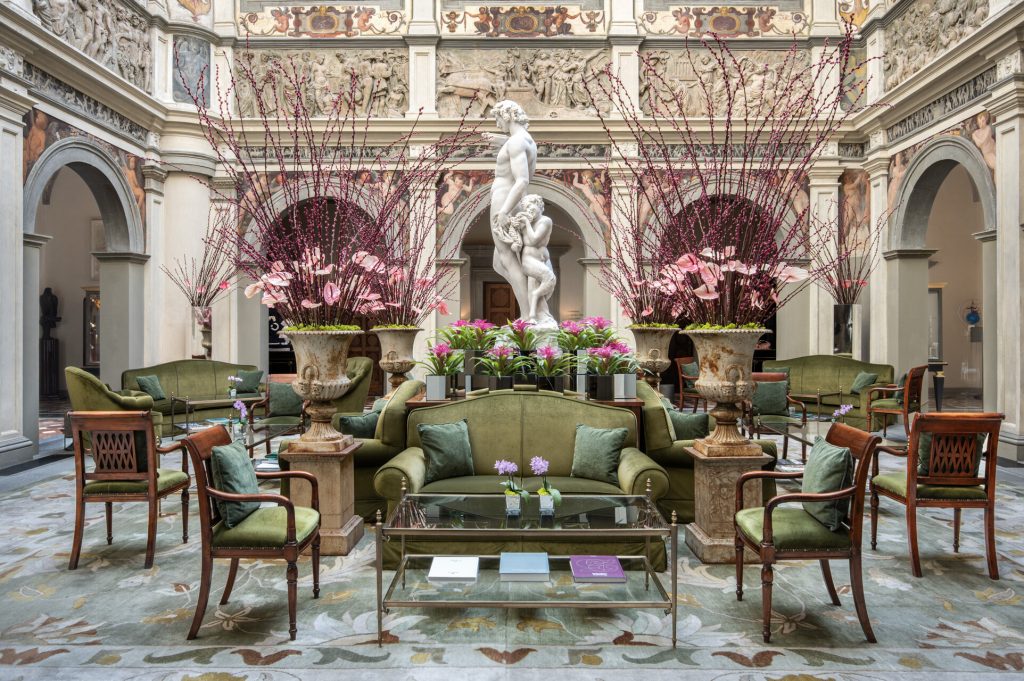
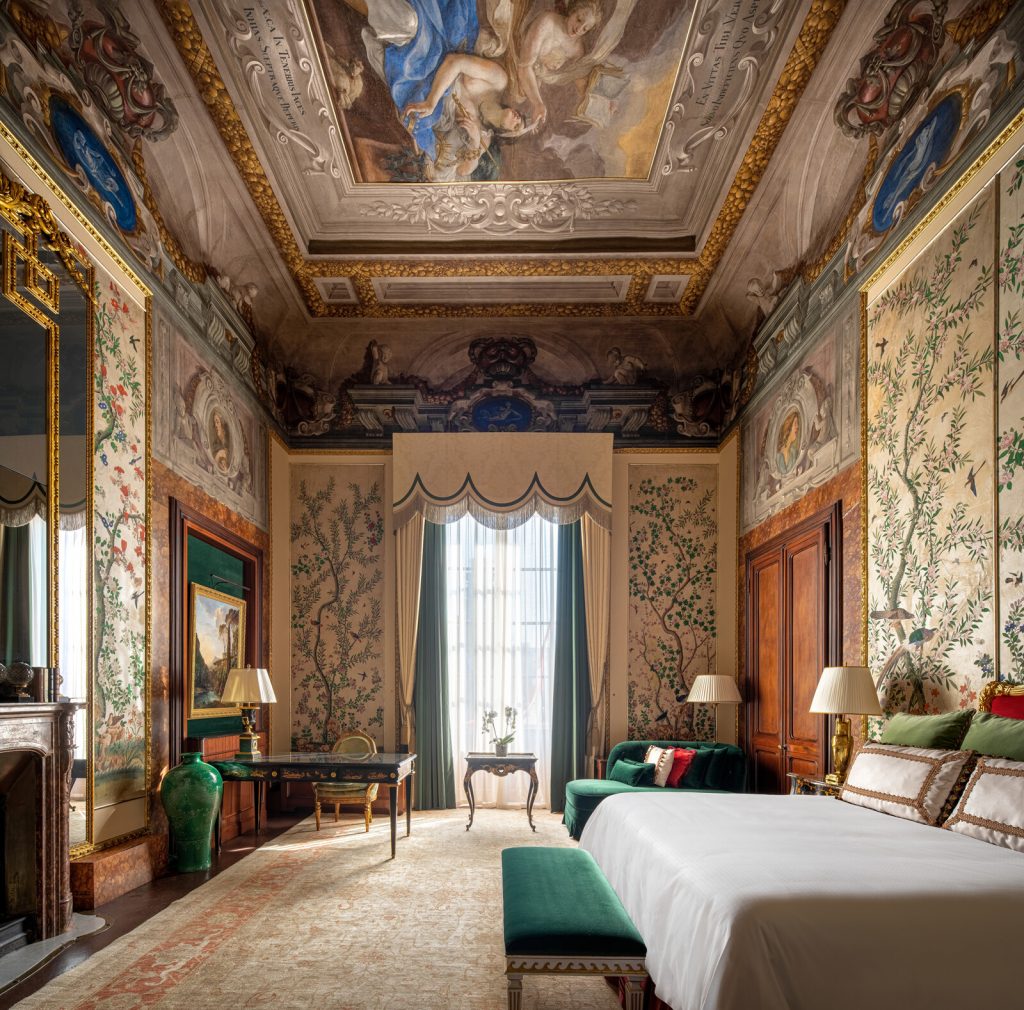
Known for his bold, pop-inflected sculptures, the artist KAWS crafted his massive new installation, “The Message,” in warmly burnished wood. The artwork—featuring two nearly 20-foot-tall figures, each of which holds a wooden smartphone—is a modern interpretation of a famous 15th-century fresco, “The Annunciation”, by Fra Angelico. Works by the Italian Renaissance painter, along with KAWS’s sculpture, are on view through January 25, 2026, at Palazzo Strozzi in Florence, Italy, which is home to Four Seasons Hotel Firenze.
Paris, France
A Christian Dior evening gown from the Fall/Winter 1951 haute couture line.
When he was a young man, in 1956, Azzedine Alaïa spent just four days as an intern at the legendary House of Dior—a fleeting experience that would leave a lasting impression. In time, he would establish his own maison, becoming known as a master of sculptural tailoring. Behind the scenes, Alaïa (who died in 2017) was also a devoted collector of vintage Dior, amassing some 600 pieces. Now his extraordinary personal collection takes center stage in not one but two exhibitions in Paris: a show, at La Galerie Dior spotlighting more than 100 of these rare pieces, and one at the Azzedine Alaïa Foundation, where Dior and Alaïa designs are shown in concert, tracing threads of influence, admiration, and creative kinship. (The former exhibition runs through May 3, 2026; the latter, through May 24, 2026.) For those who won’t be in Paris, Rizzoli and Damiani are publishing catalogues of the exhibits.—Degen Pener
Seoul, South Korea
Giant sculptures inside the Gentle Monster store.
Rising above Seoul’s Seongsu-dong neighbourhood, Haus Nowhere has quickly become a cultural pilgrimage site for shoppers seeking the next chapter in retail. Opened in September in a 14-story brutalist building, the store is the fourth experimental retail project from IICombined, the parent company of the luxury eyewear brand Gentle Monster. Yes, it sells products, including sunglasses; caps and beanies from Gentle Monster sister brand Atiissu; fragrances by Tamburins; and tableware from Nuflaat. More than anything, though, it’s an unforgettable sensory experience, complete with a colour-saturated teahouse and a rotating roster of art installations, like two painted humanoid giants sitting in meditation (above) and a gargantuan dachshund napping on the floor. It’s a concept store gone supersized.—Julie Pham
Naples, Florida
Artist James Perkins at work. Photograph by Leila Brewster.
“I’m blurring the line between what is man-made and what is made by nature,” says James Perkins (pictured above). The New York–based artist’s practice involves burying silk-covered wood frames and letting the pieces absorb the effects of sun, surf, rain, and earth. Last year year, he buried some of his latest works in Naples, Florida, home of the new Naples Beach Club, A Four Seasons Resort. Perkins is also the subject of his first museum show, Burying Painting, which runs through February 15, 2026, at the Scottsdale Museum of Contemporary Art.
The travel industry pros are starting to make their predictions for the year ahead, and, as expected, we’re seeing a wide range of opinions. European destinations are on the rise. So are African safaris. Interest in luxury tours by train is ticking up. Likewise for luxury yacht cruises (in 2026, the highly anticipated Four Seasons Yachts launches). Ahead-of-the-curve jet-setters will be flocking to Svalbard, Norway. Or maybe it’s New Zealand.
The one trend that the experts seem to agree on? Increasingly, travellers are yearning for experiences—trips that have visitors meeting locals, learning new skills, and soaking up new cultures. With that in mind, we’ve rounded up five classic, and increasingly popular, destinations that have a lot more to offer than just lounging by the pool (though, that’s also a welcome option, of course).
Lisbon
Four Seasons Hotel Ritz Lisbon offers a Sidecar Tour through the city’s narrow streets.
If you feel like everyone you know has been posting vacation photos from Portugal as of late, it’s not your imagination. According to USA Today, Booking.com data showed higher year-over-year flight searches for Portugal across every month in 2025. Roughly the size of Maine, the country has something for everyone: beaches, mountains, wineries, and eminently walkable cities.
The most popular destination in Portugal is arguably Lisbon, a city steeped in history (it’s older than Rome!) and bathed in sunlight (it’s one of the sunniest places in southern Europe). There’s no shortage of cultural sightseeing to be had here, but the capital city is not just for history buffs and architecture enthusiasts.
Those who enjoy staying active on vacations, take note: the EDP Lisbon Half Marathon is slated for March 8, 2026, and the EDP Lisbon Marathon, billed as “probably the most beautiful in the world,” will be held in October. Another event to bookmark for next year: the Lisbon Tango Festival in June, which offers five days of tango dancing, including performances, classes, and dance parties.
The Varanda Restaurant at Four Seasons Hotel Ritz Lisbon.
STAY AT: Four Seasons Hotel Ritz Lisbon. Centrally located and packed with amenities (including a rooftop outdoor running track), the hotel is a plush home base for exploring both the city and the surrounding vineyards and villages.
SIGN UP FOR: a Sidecar Tour and see Lisbon up close and personal from a vintage motorcycle driven by a private tour guide. Or consider the Sintra and Cascais Tour, a daylong excursion that hits the historical palaces at the UNESCO World Heritage site of Sintra, as well as the seaside resort town of Cascais.
Hoi An
Hoi An’s Ancient Town.
Another country enjoying a steep rise in tourism: Vietnam. According to Bloomberg, it’s now the third most popular tourist destination in Southeast Asia (behind Thailand and Malaysia). Long, narrow, and S-shaped, the country is bordered by China to the north, Cambodia and Laos to the west, and the South China Sea to the east; driving the length of it takes at least a week. Our recommendation: Head to Hoi An, the “city of lanterns” on the central coast, where you’ll be able to sample a little of everything—quiet countryside, the meandering Thu Bon River, and a picturesque beach, to boot.
Hoi An is famous for its Ancient Town, a UNESCO World Heritage site, where visitors will encounter a unique blend of centuries-old Chinese, Japanese, and French architecture set along the Thu Bon River. On the 14th of every month (when the moon is full), the neighbourhood turns off its electric streetlights in favour of colourful lanterns, creating a jaw-droppingly beautiful nightscape. For a dose of good luck, send a floating candlelit lantern down the river.
A recently renovated villa at Four Seasons The Nam Hai.
STAY AT:Four Seasons Resort The Nam Hai, Hoi An, Vietnam. The quiet beachfront property is an ideal location from which to explore nearby landmarks (including three UNESCO World Heritage sites).
SIGN UP FOR: one (or all) of the many cool cultural immersion options offered by the resort. Our pick: The Wet Rice Farm Culture experience, in which guests bike to nearby rice paddies, enjoy tea with a farmer, learn rice cultivation, and end with a meal with the farmer’s family. (And don’t forget to take advantage of the complimentary Vietnamese Coffee Tasting on Wednesdays at 2:30 p.m.)
Tokyo
The neon lightscape in Tokyo is unparalleled.
Japan shares the top spot with Vietnam for the highest tourism growth rate in the first half of 2025 (a whopping 21 percent increase in international travellers compared to the previous year, according to the World Tourism Barometer, published by UN Tourism). And the most visited destination in Japan? Tokyo, of course.
Often cited as the most populous city in the world, Tokyo is nothing if not bustling. Visitors won’t lack for things to do in this metropolis that exquisitely mixes the futuristic with the ancient. Whatever you’re interested in, there’s probably a market, festival, or celebration devoted to it. A few particularly unique events to bookmark for your trip to Tokyo in 2026: the January, May, and September Grand Sumo Tournaments; various cherry blossom festivals in late March to early April; and the Sanno Matsuri, a days-long, mid-June festival, held only on even-numbered years, that showcases traditional Japanese music, dance, and drum performances, prayer ceremonies, and a Shinto ritual parade.
All guest rooms at Four Seasons Hotel Tokyo at Otemachi enjoy incredible city views.
STAY AT: Four Seasons Hotel Tokyo at Otemachi. Perched on the top floors of a 39-story high-rise in the financial district, the hotel is located right next to the Imperial Palace. (Reservations at Four Seasons Hotel Tokyo at Marunouchi are currently unavailable, as it is undergoing renovations; it’s set to reopen in the spring of 2026.)
SIGN UP FOR: the Suibokuga class to try the art of Japanese ink wash painting or the Kodo workshop to learn the art of incense appreciation. First time in Tokyo? Consider joining the hotel’s Tokyo Essentials guided tour of the city’s landmarks and neighbourhoods.
Milan
The Piazza del Duomo in Milan.
The Milano Cortina 2026 Winter Olympics will be held at multiple locations in Northern Italy in February, including Milan—which means that all eyes will soon be trained on the unofficial design and fashion capital of the world. This is good news for anyone hoping to visit Milan next year, as it will be dressed to the nines and more than ready to play host.
Other much-anticipated events include Design Week in April (composed of the renowned furniture fair Salon Internazionale del Mobile and Fuorisalone, a series of design-focused exhibitions and happenings throughout the city) and the thrilling Italian Grand Prix in Monza, in September. But you don’t need a tentpole event to visit—with its alluring triumvirate of fashion, food, and frescoes, Milan is truly wonderful any time of the year.
A Premium Room at Four Seasons Hotel Milano.
STAY AT: Four Seasons Hotel Milano. The 15th–century convent turned luxury hotel is located in the heart of the Fashion District, just steps from the Duomo di Milano, the iconic and intricately designed Gothic cathedral that took nearly 600 years to build.
SIGN UP FOR:day trips to Lake Como, Courmayeur Mont Blanc, and the Franciacorta vineyards for some Northern Italian fresh air. And if it’s more of Milan you want, you’re in luck—the hotel offers walking tours, after-hour museum visits, private shopping excursions, and more.
Sydney
Sydney’s Bondi Beach.
Condé Nast Traveller UK’s Readers’ Choice Awards named Sydney “Best City in the World” last year, citing the “indoor-outdoor way of life the Aussies embrace so well” as the reason it’s so beloved by visitors. (Where were Paris, Tokyo, and New York, you ask? In the No. 6, No. 12, and No. 20 spots, respectively.)
The best way to have an authentic Aussie experience: get outside. In Sydney, that means heading to the beach (there are more than 100 to choose from, including famous Bondi Beach, where you can learn to surf), cruising Sydney Harbour (home to two world-renowned feats of engineering, the Sydney Opera House and the Sydney Harbour Bridge), strolling the 74-acre Royal Botanic Gardens of Sydney, or bushwalking nearby Blue Mountains.
The Sydney Harbour Studio Club Suite at Four Seasons.
STAY AT:Four Seasons Hotel Sydney. The property not only has epic views of Sydney Harbour, but also is just steps from the Rocks, Sydney’s must-visit oldest neighbourhood.
SIGN UP FOR: the Outback Opal Mine Adventure and tour the region’s oldest opal mines with the stars of the hit reality TV show Outback Opal Hunters. Who knows? You may get lucky and strike opal.