What is “rare”? These days, it seems everyone, particularly in the realm of luxury goods and services, wants to claim that adjective. But rarity, by definition is not something everyone can attain or purvey.
The rare is often luxurious, but costliness is a corollary, not a condition. The rare is an experience or a discovery that’s once in a lifetime; it is a thing that, by virtue of its aesthetics, its origins or its age, is an object of profound passion for the connoisseur. We encounter the rare only when we search for something that’s precisely right in every detail.
Here, we profile individuals who have devoted their lives to that search, and to sharing their discoveries: elusive ingredients, unusual adventures, obscure books and mysterious gems.
Iceberg diving
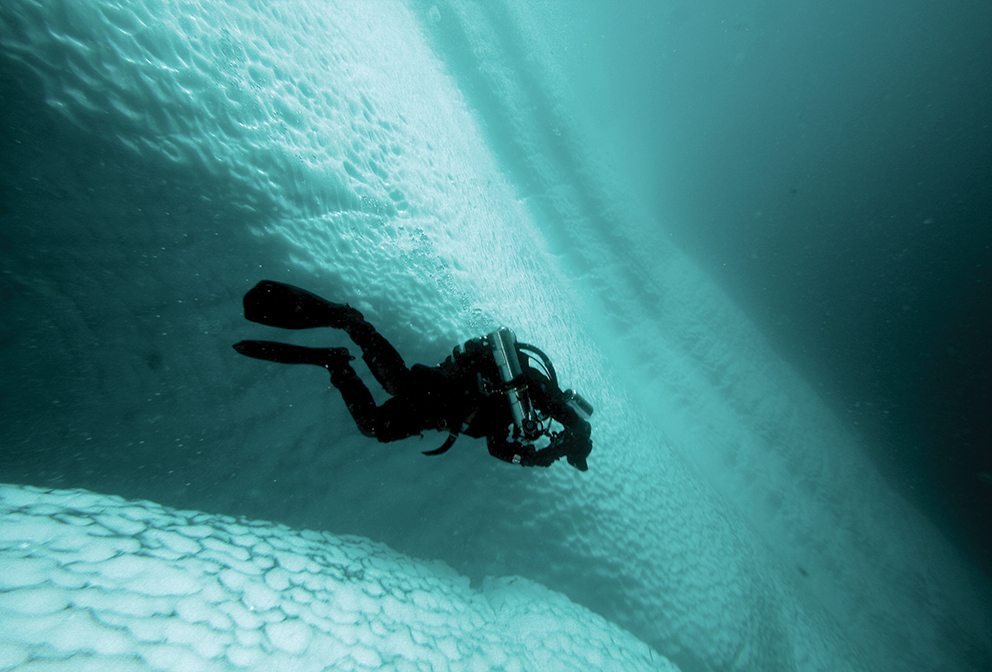
Based in Conception Bay, Newfoundland, Rick Stanley is one of the world’s only iceberg dive instructors. Photography courtesy Rick Stanley
“They melt and change by the millisecond,” says Rick Stanley of the ephemeral settings for his work. “They can roll and explode at any minute, so it’s important to stay down deep. This reduces the risk, but never eliminates it.”
Every spring from April to June, this part of Iceberg Alley – the long, cold stretch of the Labrador Current that runs from Greenland and Baffin Bay to New Zealand – teems with calved cubes, bergy bits and ship-threatening growlers (the type of submerged iceberg believed to have sunk the Titanic).
Eastern Newfoundland, where massive hunks of ancient ice may ground themselves on or near the coast, is the best place on Earth to see icebergs from shore – and the best place to see them up close. “Dives like this are not offered anywhere else in the world,” Stanley says, “so I saw an opportunity and grabbed it.”
Stanley started diving in 1992 as a way to forage for mussels and scallops, but developed a deeper passion for the marine world. Today, as a certified rebreather diver and full cave diver, his mission is to show others icebergs’ primordial beauty.
Along the way, he has spotted unicorn-like narwhals and majestic humpbacks, but it’s the icebergs that continue to captivate him. And his underwater vantage point is not one achieved by many other souls: Stanley estimates that he’s guided about 300 iceberg divers in nearly 20 years, and probably a few more have had similar experiences elsewhere in the Arctic and Antarctic.
Since the risk of such an endeavor is high, Stanley’s Ocean Quest Adventures company takes on only super-experienced divers, with a certification level of Rescue Diver and 200 dives logged. Helmets, drysuits and extreme caution are required. Those lucky enough to meet the criteria get a chance to swim close to the rare, millennia-old floating sculptures and observe their intense spectrum of colours, from crystalline sapphire to deep indigo.
Educating divers about icebergs is paramount to Stanley, who helped found Ocean Net, a group dedicated to sustainable marine tourism. “What’s most important to understand about icebergs is that they are forces of nature, and they’re dangerous,” he says. “Even the small ones can be massive underwater, making you feel tiny in comparison. But the beauty of them is that they are sculpted by the sea – a rare masterpiece that’s continually changing… until it’s gone.”
Text by Adam H. Graham
Exotic ingredients
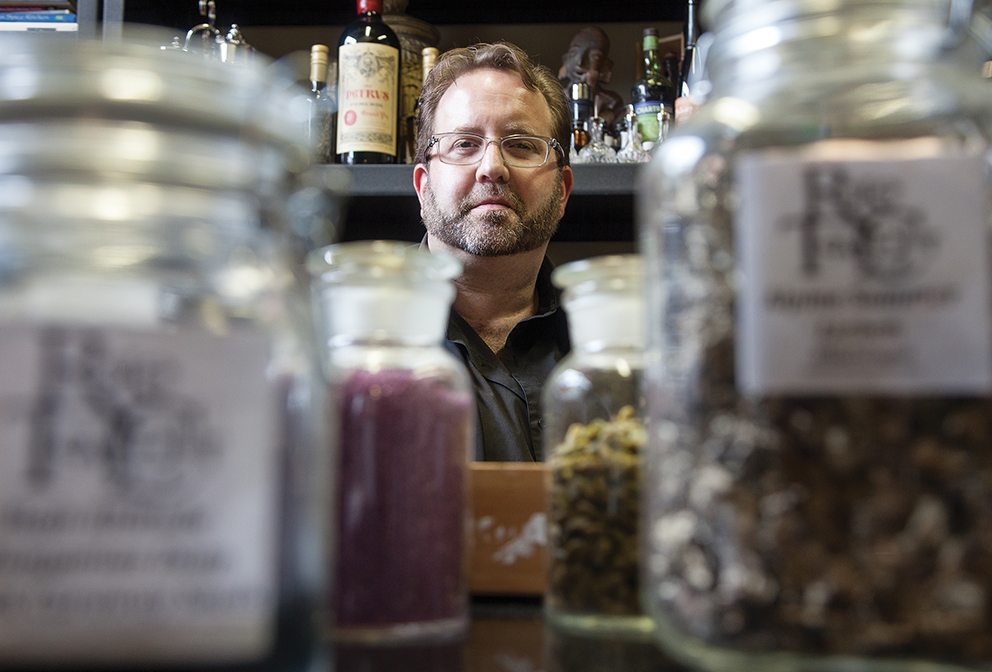
Even in a culinary world that increasingly relies on local and seasonal sourcing, “I think there’s always an angle to bring in a rare ingredient,” Rodrick Markus says. “It’s a way to wake up the palate.” Photography courtesy Lara Kastner
“I just got the first five beans through customs a week ago,” says Rodrick Markus as I bite into a raw white Amazonian cacao bean, his latest obsession. It tastes remarkably smooth and nutty, reminiscent of a roasted fava bean.
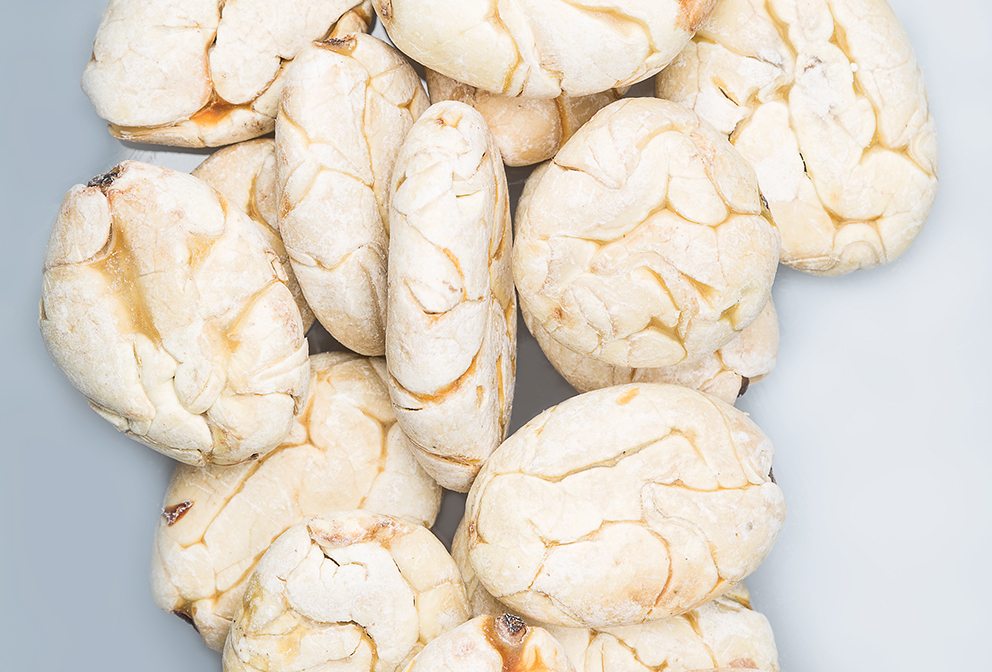
The albino offshoot of a cacao variety only recently rediscovered in Peru, the white Amazonian cacao bean is a rare natural mutation of an already rare plant. Photography Courtesy Lara Kastner
Markus’ unassuming Chicago warehouse is a culinary wonderland. The more than 4,000 different ingredients here make up a specialty grocery of a most unusual kind, supplying 1,200 restaurants with hard-to-find goods. Think purple honey and wild hickory nuts. The honey appears infrequently in a small area of the southeastern U.S., often in particularly dry weather and for otherwise mysterious reasons. And the nuts are rarely found for sale because the shells are extremely difficult to crack while preserving the kernels. Markus even stocks lemon peel from a varietal that grows only alongside the Egyptian pyramids.
His obsession with the extraordinary started at age 24, when he cast aside his degree in psychology to start Rare Tea Cellar, with a focus on sourcing exotic teas. His breakthrough came when chefs like Thomas Keller and Grant Achatz started asking him for individual botanical ingredients from his tea blends.
Suddenly it wasn’t just about tea – it was about obscure delicacies like Hungarian honey truffles, found beneath black locust trees along the Danube.
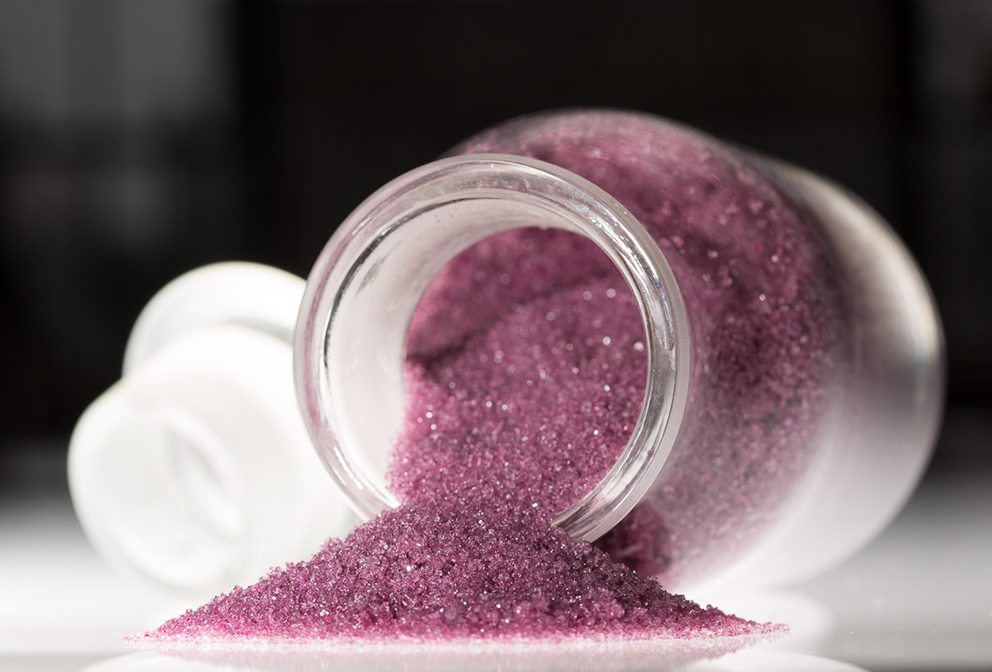
To extend his collection of rare ingredients (such as violet sugar, pictured here), Markus employs biodynamic farmers in India and foragers from Fogo Island to Kyoto. Photography courtesy Lara Kastner
Today, top chefs have him on speed dial; he even appears on a billboard in Singapore. Markus’ latest endeavor is making his own black truffle bitters – the world’s most expensive cocktail bitters, at US$75 for 55 ml. With his exacting sense for finding the precise ingredients to create the flavour he wants, the bitters are sure to be in hot demand.
The 3,000 bottles he made of Balsam American Amaro, which he calls a “game changer in the vermouth movement” because it can turn any wine into bespoke vermouth, sold out in two hours last March. Along with the specific flavours that uncommon ingredients can add to a dish, they can also create a next-level element of surprise.
Text by Amber Gibson
Indian books
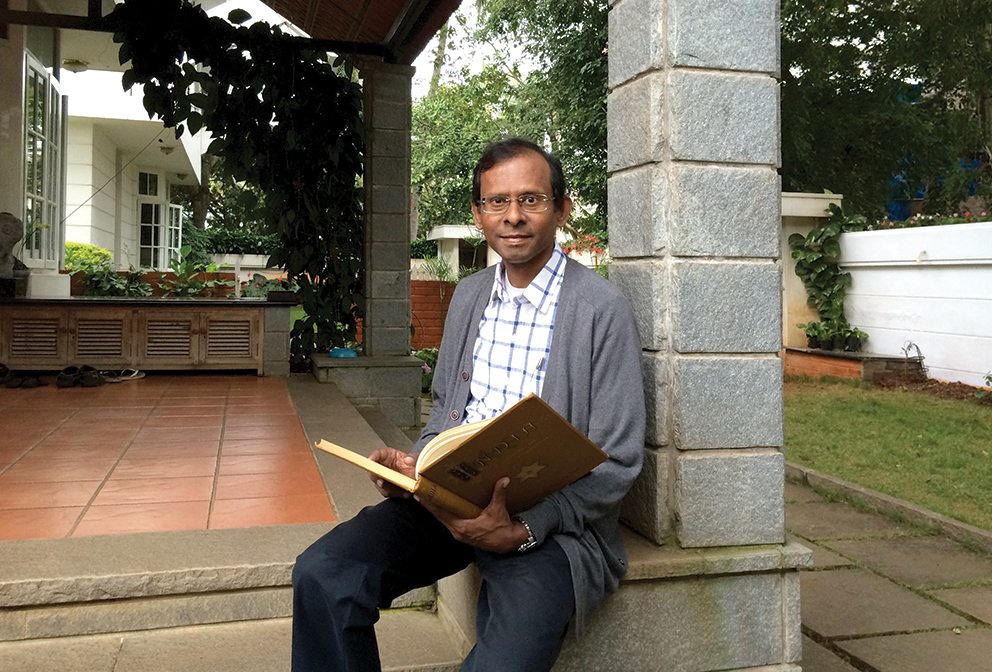
Subbiah Yadalam hasn’t always been impressed by rare books. Before age 42, he was merely an avid reader, from a prominent family in Bangalore. Photography courtesy Subbiah Yadalam
One day, while browsing at the Bangalore Club library, Subbiah Yadalam came across a 1909 encyclopedia, Castes and Tribes of Southern India, the likes of which he had never seen. The feeling it gave him launched a treasure hunt that would change his life.
“The thing about a rare, antiquarian book,” he says, “is that it does not look valuable on its face. It is, after all, just a book. But when you learn about its age and its rarity, you see it in a completely different way.”
He asked to purchase the seven-volume encyclopedia, but the club refused to sell it. Determined to find a first edition, he scoured bookstores, auctions and websites around the world that specialised in limited titles. Eventually, he tracked down a copy in his own backyard at K.K.S. Murthy’s Select Book Shop, one of the few rare-book dealers in Bangalore. For 15,000 rupees (US$230), he had accomplished his goal – and sown the seeds of a much bigger one.
“The idea of ‘the rare’ has always been there,” Yadalam says. “Any object of antiquity has always been treasured and valued.” But India, despite being an ancient literary civilisation – in possession of a wealth of rare items, handwritten and printed – did not have a society for rare-book collectors.
“The rare has greater relevance today than at any other time in history,” Yadalam says. “Along with education and prosperity comes the ability to appreciate the finer things of life, and also the desire to learn about and preserve one’s heritage.”
Yadalam set out in 2009 to merge those two objectives by founding the Rare Book Society of India online. His idea was to increase interest in books that are scarce by broadening access for his countrymen and for anyone interested in learning about India through its ancient tomes. The Rare Book Society sources precious volumes of Indian history and culture from digital libraries and museum collections and posts them – preserving the original look of each page – for free online reading or download.
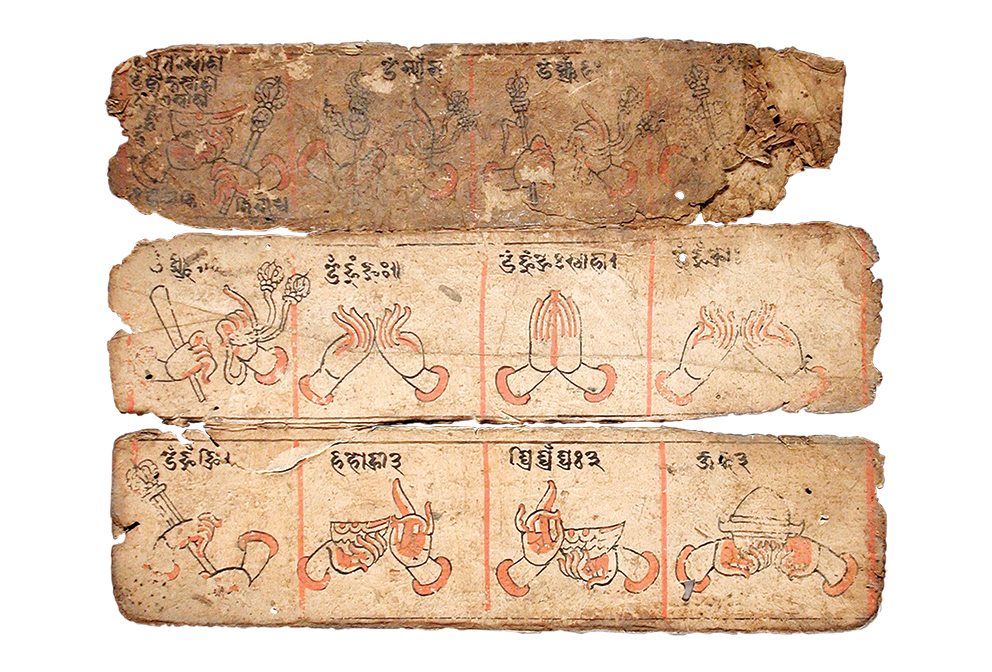
Opaque watercolour and ink on paper, these three folios are from a 15th-century book of iconography. Photography courtesy Los Angeles County Museum of Art
Yadalam is not troubled by the paradox of celebrating the rare by putting its contents within easier reach of a wider audience. History, he says, is complicated, so any real understanding of the past must begin with as many people as possible reviewing the works created as that history was lived. He hopes young people in particular will view the society’s digital versions of books and “want to learn more and collect them.”
With a personal library of about 175 rare hard-copy literary works, Yadalam wholeheartedly believes that nothing can replace the feeling of an in-person encounter with such a title, the feeling he had when he first turned the pages of Castes and Tribes of Southern India. With only 25 to 250 copies of many such books available in the world, he says, their singularity will only increase with time: “Their rarity is frozen forever.”
Text by Doris Goldstein
Uncommon gemstones

Instead of relying on diamonds, the Parisian fine-jewellery designer Lydia Courteille has built her career by crafting statement pieces with the rarest of gems, melding the science of gemology with the art of high fashion. Photography courtesy Lydia Courteille
There’s nothing more thrilling for Lydia Courteille than encountering a gemstone so obscure that she has never before heard its name. Courteille travels the world in search of unusual stones like “grape jelly purple” sugility, whose only gem-grade deposit lies 3,200 feet (975 metres) below the surface of South Africa. (Diamond mines typically go no deeper than 2,000 feet, or 609 metres.) With this logistical limitation, much of the sugilite remains in the ground, and what is mined fetches a high price.
Her rarest find yet? A 60-carat hessonite garnet, which she used in a ring as part of her Garden of Xochimilco collection. (Anything over 10 carats is considered a rare find for a coloured gemstone.)
The certified gemologist, scientist (she holds a degree in biochemistry) and antiquarian transitioned from buying and selling vintage pieces to creating her own jewellery about two decades ago, when she perceived a lack of originality in modern works.
“My idea,” Courteille says, “was to design pieces unlike anything else out there.” Uncommon gems have certainly helped her work stand out. Women buy her jewellery not simply because it’s luxurious, like a piece laden with the finest diamonds, but also for the love of singular stones and creative designs.
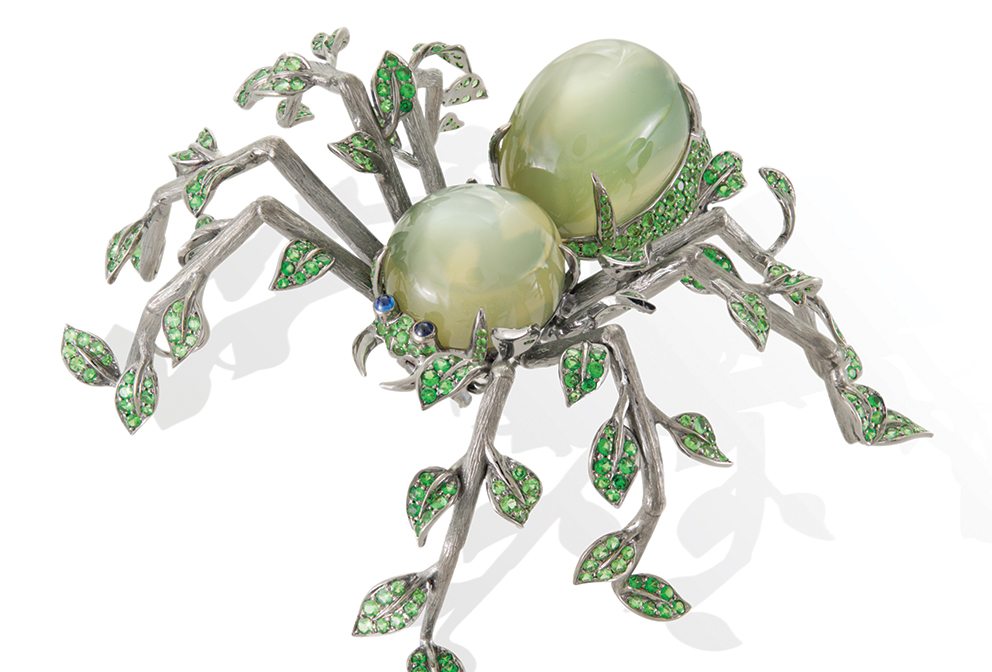
Lydia Courteille’s homage to the surreal collection includes this spider brooch composed of rare green tsavorite leaf legs, sapphire eyes and moonstones for the body – all in black rhodium gold. Photography courtesy Lydia Courteille
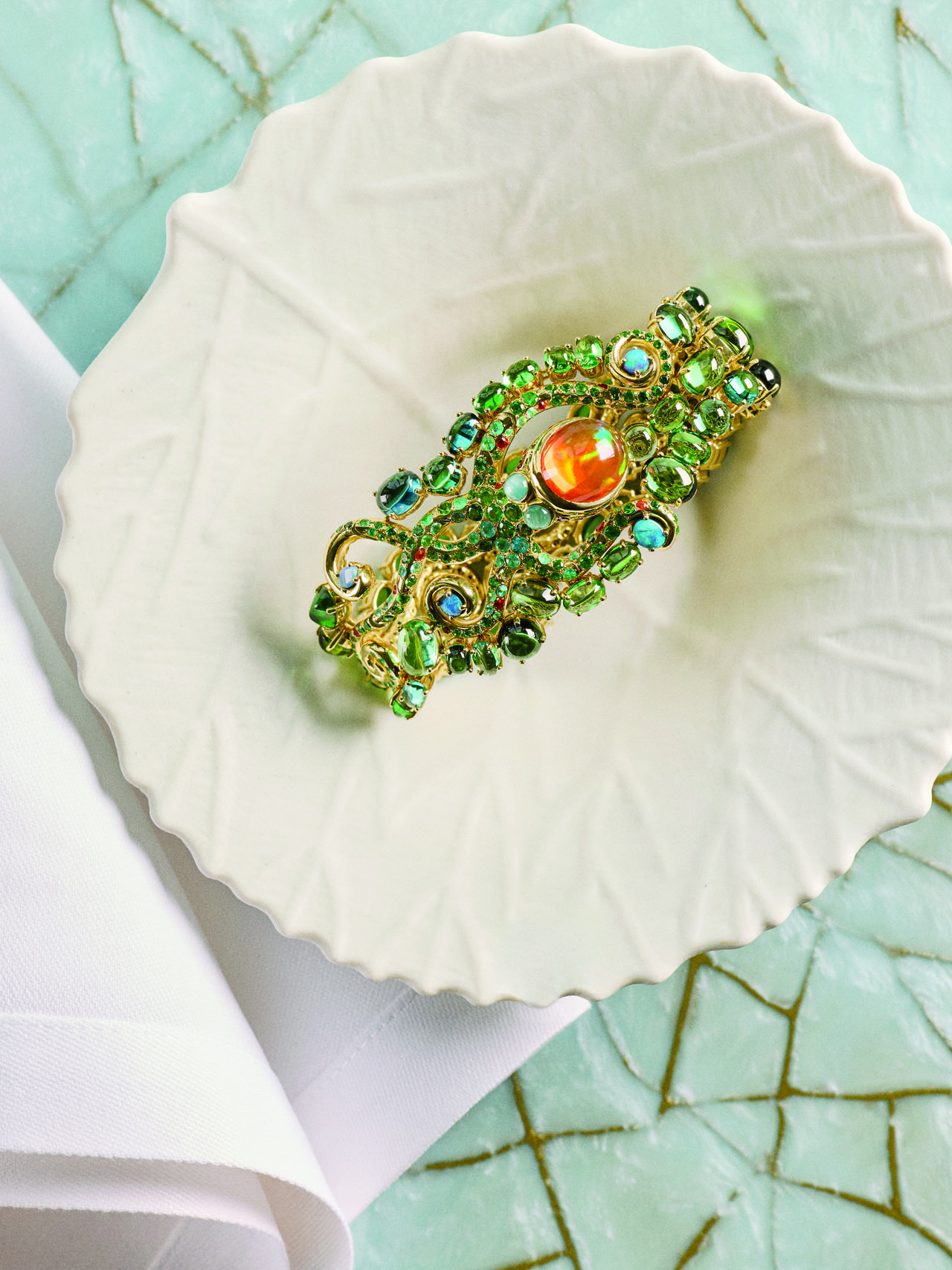
Given that the jewels Courteille works with are so scarce, most of her bijoux are unique. Take the cuff from her Amazonia collection with vivid green tsavorites, 1,000 times more rare than emeralds and particularly hard to find in sizes over 3 carats. A variety of grossular garnet, tsavorite is mined in fine gem quality only in East Africa. Such unexpected stones help her create pieces that feel bold, rebellious, provocative. “She has a genius for making jewellery,” Karl Lagerfeld has said.
With her daring designs featuring some of the most intriguing and unusual specimens found in nature, Courteille’s atelier off Place Vendôme is like a cabinet of curiosities. Does her preference for extraordinary gems limit her creativity? On the contrary, Courteille says. It gives her more freedom. “My quest to find rare stones is ongoing,” she says. “And there are always new ones being discovered – that means endless possibilities.”
Text by Shivani Vora