7 Pieces of Art You Didn’t Know to Look For

The Mona Lisa, Starry Night, Dalí’s Persistence of Memory – we all need to see these show-stoppers, but visitors can forget that they’re in a museum full of equally beautiful, intriguing artworks. Because of their more famous neighbours hanging nearby, these 7 paintings and art installations are some of the most undeservedly overlooked masterworks in the world.

London: Saint Margaret of Antioch


Francisco de Zurbaran’s Saint Margaret of Antioch. On Display at the National Gallery

Encounter St Margaret’s direct gaze, but take a moment to admire the painter’s attention to detail and the menace of the dragon beneath her feet.

You’re in London, at the National Gallery, and your first port of call – naturally – will be Van Gogh’s iconic Sunflowers, hanging in Room 43. But for one of the gallery’s curators, Francesca Whitlum-Cooper, it’s Francisco de Zurbaran’s Saint Margaret of Antioch (in Gallery 30) that shouldn’t be missed.

“Every time I look at Zurbaran’s picture of Saint Margaret,” Whitlum-Cooper says, “I fall in love with the bright red of her skirt, her beautifully painted alforjas, or saddlebags, the amazing geometric swirls of her straw hat – it’s a surprise every time to look down at her feet and remember that there’s a menacing dragon prowling around them.”

“To me, there’s something very modern and powerful about Saint Margaret’s direct gaze,” the curator continues, “so cool and calm, so confident in her faith, the dragon’s presence doesn’t bother her in the least.”

Four Seasons Hotel London at Park Lane

Paris: Death of the Virgin

While the notorious crowd swarms around Leonardo’s most famous work, the Mona Lisa, at the Louvre, slip away to see Caravaggio’s Death of the Virgin (1606). This Italian baroque masterpiece shows the Virgin Mary’s mortal body as you’ve never seen it depicted before. The painting is so intense that it was rejected by the monks at the church it was intended for, Santa Maria della Scala in Rome.

Four Seasons Hotel George V, Paris

Los Angeles: Portrait of a Girl/Still Life With Fan
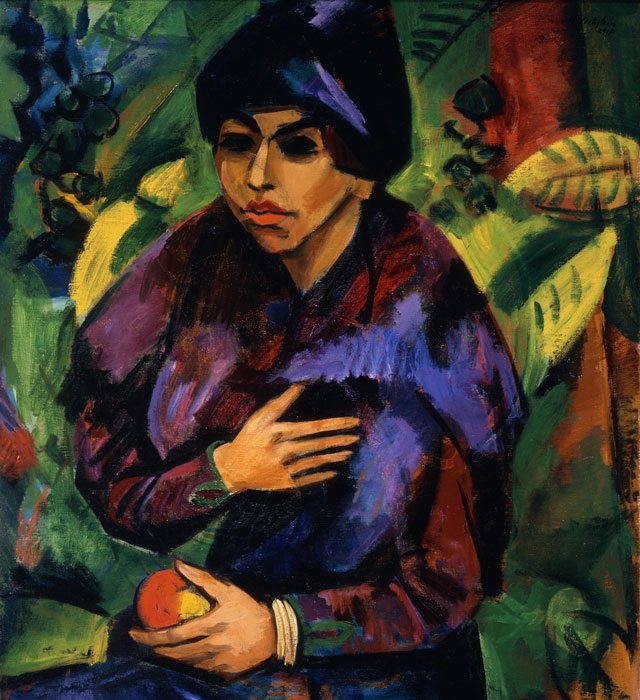

Max Pechstein's Portrait of a Girl/Still Life With Fan on display at the Los Angeles Country Museum of Art

Highlighting the dark, oppressive environment of Europe’s post-war period, Portrait of a Girl/Still Life With Fan served as the beginning of a breakthrough for artists Wassily Kandinsky and Emil Nolde in art’s contemporary period.

When you go to LA’s most famous art museum, Los Angeles Country Museum of Art, chances are you’ll flock to see Diego Rivera’s Día des Flores (Flower Day), 1925. It’s one of his most iconic depictions of the indigenous peoples of Mexico, and the first major Rivera painting to enter a public art collection in the U.S. But as you meander through the collections, be sure not to overlook the paintings of German expressionist Max Pechstein.

Although he’s not as well known as his contemporaries Wassily Kandinsky and Emil Nolde, he played an important part in the breakthrough of the style. Pechstein survived the turmoil of the 20th century – and was incredibly skilled at translating this onto the canvas. His painting Portrait of a Girl/Still Life With Fan, painted in 1919–20, captures the dark, meditative atmosphere of the post-war period in Europe.

Four Seasons Hotel Los Angeles at Beverly Hills

Seoul: Matrilineal Society in Asia – China #4

You can find the work of American greats, such as Andy Warhol and Jeff Koons, at the Seoul Museum of Art. But it would be a shame to miss the emerging Korean artists that the museum nurtures and showcases. Admire Bek Ji Soon’s photographic portraits of women from across South East Asia, particularly her photograph Matrilineal Society in Asia – China #4, in which a young girl in traditional clothes – confident and joyful in her gaze – sits front and centre. It’s a unique way to get acquainted with the city’s locals and learn more about the culture.

Four Seasons Hotel Seoul

New York: One: Number 31, 1950
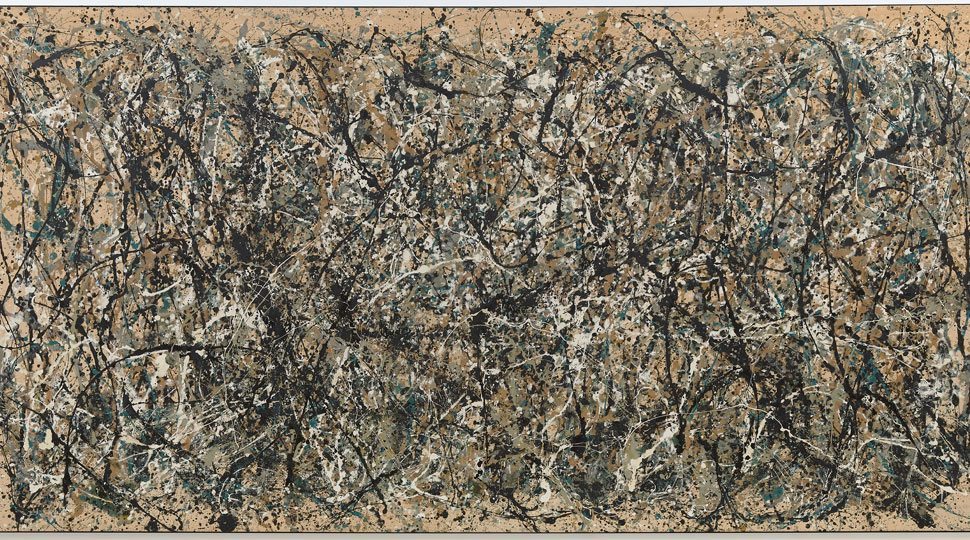

Jackson Pollock’s One: Number 31, 1950. On Display at the Museum of Modern Art.

One of the “drip” paintings Pollock created by pouring and drizzling paint from above, One: Number 31, 1950, highlights the artist’s technical expertise.

If you’d rather avoid the masses crowded around Starry Night, another of MoMA’s must-see paintings is on the same floor. Jackson Pollock’s One: Number 31, 1950 is an iconic piece of American abstract expressionism that is often overlooked since it doesn’t really “look like” anything in the conventional sense. But what you’re really seeing in this painting is Pollock’s dramatic, dynamic movements, throwing paint (and himself) around. It can’t be missed.

Four Seasons Hotel New York Downtown

Mumbai: Maratha Lady

While visiting Mumbai’s renowned colonial-era Dr Bhau Daji Lad Museum, it would be difficult to miss Rao Bahadur MV Dhurandhar’s Court Scene, an early 20th-century watercolour. Bahadur was known for capturing the busy scenes and colourful characters of early 20th-century Mumbai, then known as Bombay, and this is a perfect example.

But another of his works, Maratha Lady from 1916, should not be overlooked. Rather than depicting a busy scene, here Bahadur focuses on one strong woman looking straight at the viewer, with a rural scene in the background. At the same time, the soft fabric of her sari shows her softer side, in sync with the rolling hills behind her.

Four Seasons Hotel Mumbai

Chicago: The White Place in the Sun
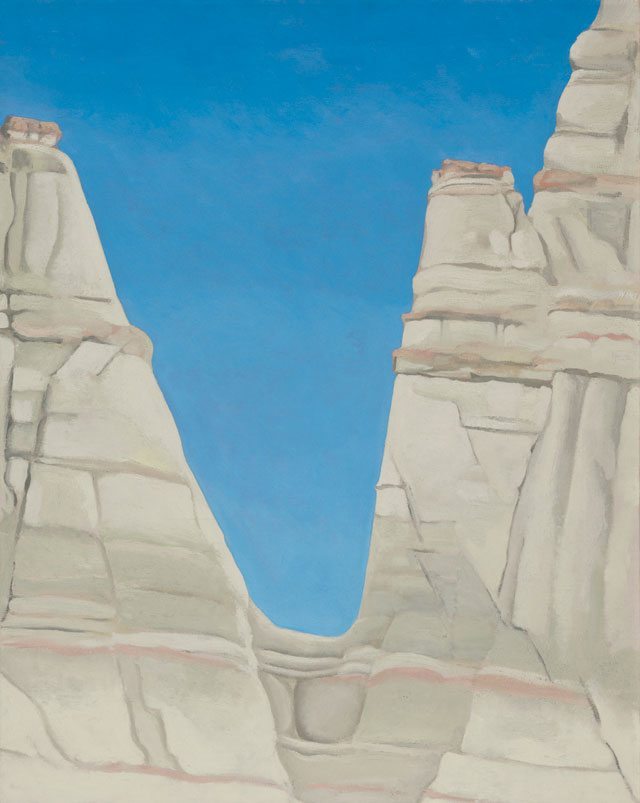

Georgia O’Keeffe’s The White Place in the Sun (1943). On display at the Art institute of Chicago.

At the Art Institute of Chicago, steal away to find O’Keeffe’s White Place in the Sun, which brings to life the smooth and stunning rock formations of New Mexico.

The Art Institute of Chicago is home to Edward Hopper’s Nighthawks (1942), one of the best-known artworks to emerge from 20th-century America, so it’s no surprise that it draws a lot of visitors. While you wait for the crowd to thin out, make your way to AIC’s Gallery 265 and see Georgia O’Keeffe’s The White Place in the Sun (1943). This shows you a completely different side of the U.S. – the sparse desert and smooth yet striking rock formations of the White Place near Abiquiu in New Mexico. The geological formation in the White Place had been smoothed and whittled by water and wind over centuries, until it eventually resembled spires and cliffs, and O’Keeffe contrasts its undulating shapes with the bright blue sky.
Your Journey Begins Here

Select a city and start planning your next artful escape.

6 Rooms, Pools and Lobbies
You Have to See to Believe

If you’ve seen one Four Seasons hotel or resort, you haven’t seen them all. Each of our more than 100 properties reflects its own sense of place, innovation and style.

Through our international collection of awe-inspiring lobbies, dynamic restaurants and bars, re-energizing fitness and spa facilities, impressive event spaces, and perfectly appointed rooms, Four Seasons delights with design.

Here, marvel at some of our creative spaces, then get a behind-the-scenes look at the design process.

Kuw 207 970x540

A pool and spa that reflect tranquillity

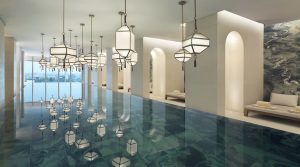
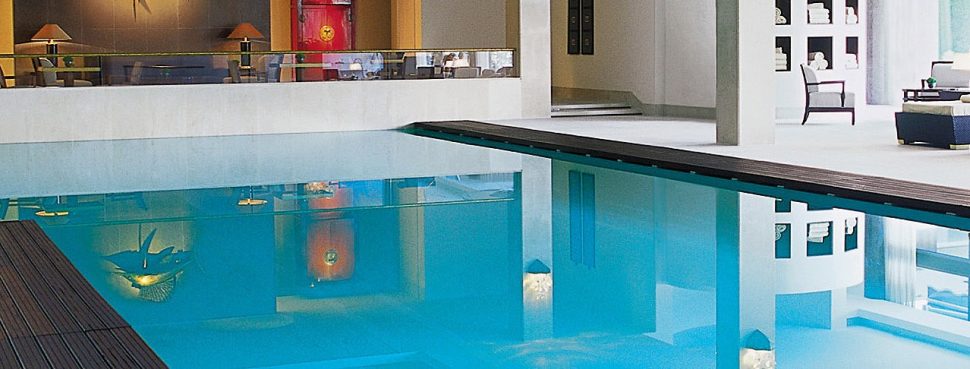
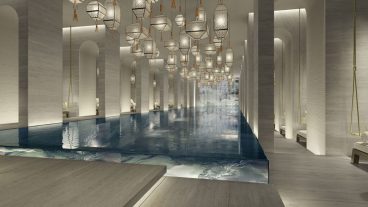
At Four Seasons Hotel Kuwait at Burj Alshaya, the design for the pool, spa and fitness section was driven by the theme of peacefulness mixed with a specific sense of place. The glowing lanterns create a warm reflection in the pool (recently named the best indoor swimming pool in the Middle East by Prix Villageiture), and archways and alcoves create semiprivate, intimate lounging areas for guests.

“The fitness areas emphasize light, air and volume,” says Didier Jardin, General Manager at the Hotel. “In spas, dimmer lighting and quiet spaces are really conducive to relaxation.”

The grotto oasis aspect of this design by Yabu Pushelberg evokes a calming and inviting aura. “The Hotel was designed with a refined, well-travelled and culturally informed guest in mind and has a distinct connection to place in its design elements,” says co-founder Glenn Pushelberg.

Celebrating eccentricity at the bar

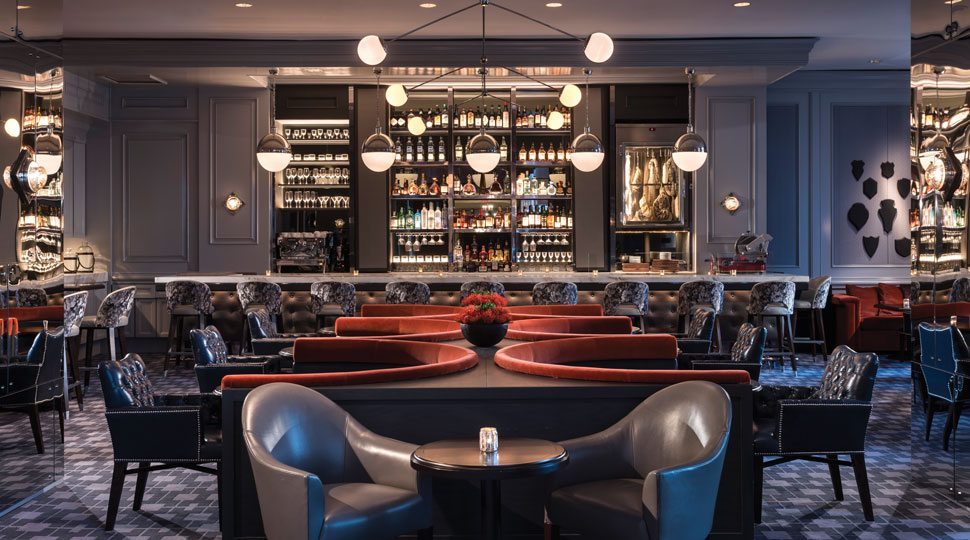
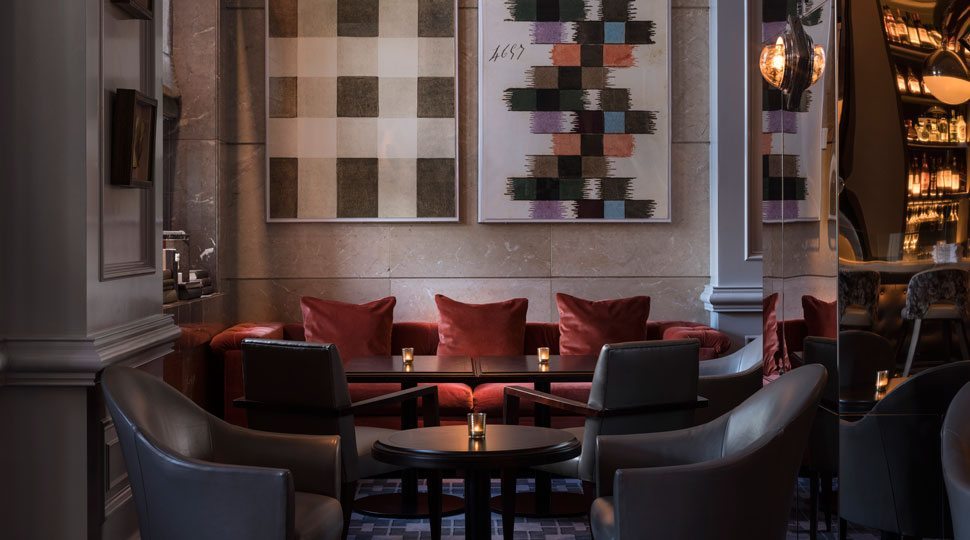
It was the independent child prodigy Margot Tenenbaum, from the 2001 U.S. film The Royal Tenenbaums, who inspired the renovated bar at Four Seasons Hotel Atlanta. Bar Margot celebrates interesting people, individualism and eccentricity.

“The way you make a place ‘happening’ is with a strong sense of narrative and of place,” says Will Meyer, partner of Meyer Davis, which co-led the 2015 renovation.

Those familiar with the film will instantly feel transported into the world of Margot Tenenbaum upon entering the restaurant and bar. Throughout the velvety-rich space, tokens from the cult classic film adorn the walls, window ledges and bookshelves.

The Hotel completed a dramatic transformation of its meeting and event space this year. In collaboration with Hirsch-Bedner Associates, the total 17,436 square feet (1,620 square metres) has been revitalized to fuse the Hotel’s majestic opulence with the latest technology.

Dining under glass


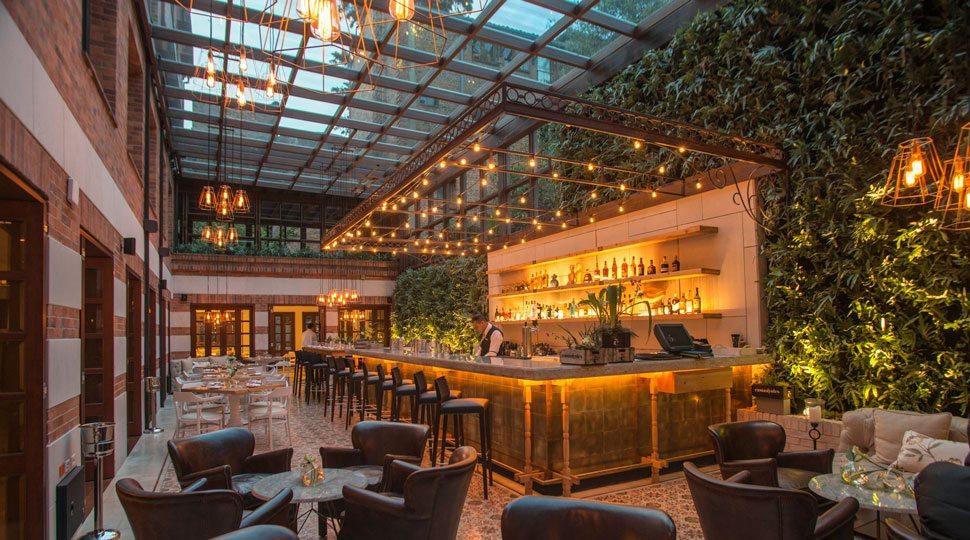
Castanyoles restaurant in Four Seasons Hotel Bogotá Casa Medina

The barrier between indoors and outdoors blurs in this restaurant and tapas bar, where a lush atrium courtyard and a retractable glass ceiling can swiftly create al fresco dining.

Neighbourhood chic meets rustic nature in the design of Castanyoles, at Four Seasons Hotel Bogotá Casa Medina. The Spanish restaurant and tapas bar, designed by local Saul Sasson, integrates warm colours, Spanish tiles and modern furnishings underneath a stunning glass atrium roof.

The restaurant – named for the traditional handheld percussion instruments also known as castanets – was designed to reflect the way people dine today.

“Castanyoles is the ideal spot to share a Spanish bite or a handcrafted cocktail,” says Mark Bingle, General Manager of the Hotel. “We have an amazing space that allows for indoor dining with open-air elements, enhancing the elegant atmosphere.”

Seaside sanctuaries

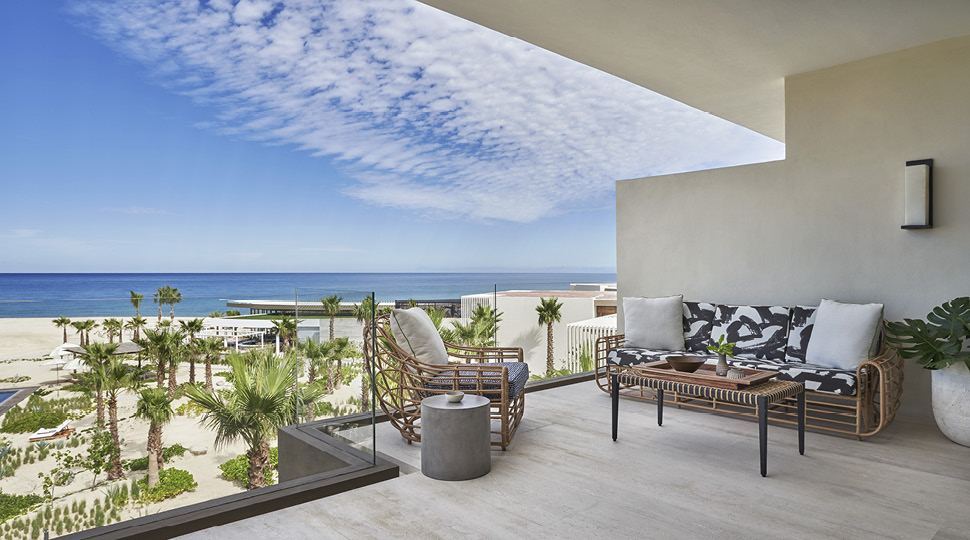
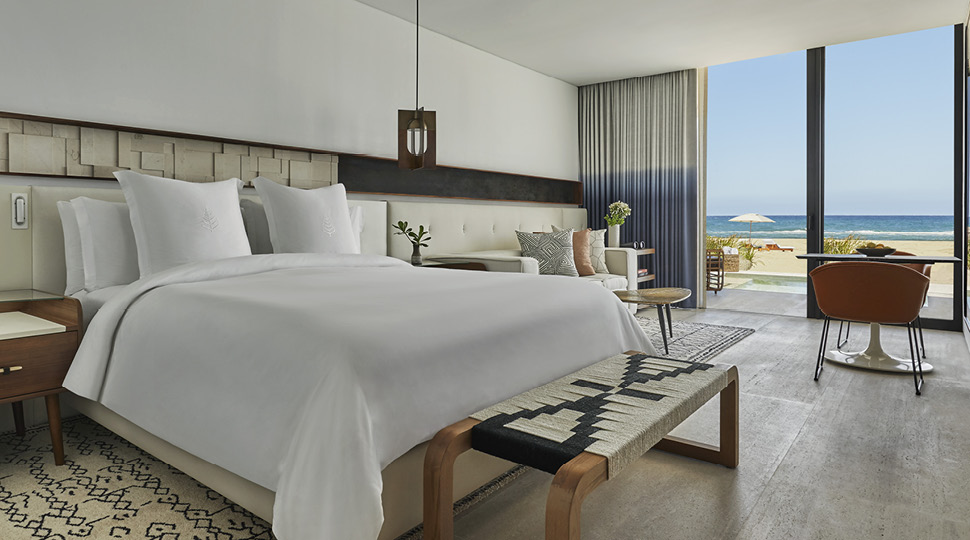
At Four Seasons Resort Los Cabos at Costa Palmas, it was the nearby ocean that fuelled the design team’s creation of livable luxury. The guest rooms incorporate oversized relaxation areas that seamlessly flow onto outdoor ocean terraces.

We call our guest rooms ‘sanctuaries,’” says Borja Manchado, General Manager at the Resort. “It’s about welcoming guests and giving them the best night’s rest they’ve ever had.

TAL Studio designed the guest rooms. “Four Seasons guests value artistry, craft, authenticity, cultural context and sincere hospitality that is truly anticipatory of their needs, and these values inform our design,” says studio founder Todd-Avery Lenahan.

Modernizing history in the lobby


Processed With Vsco With A4 Preset

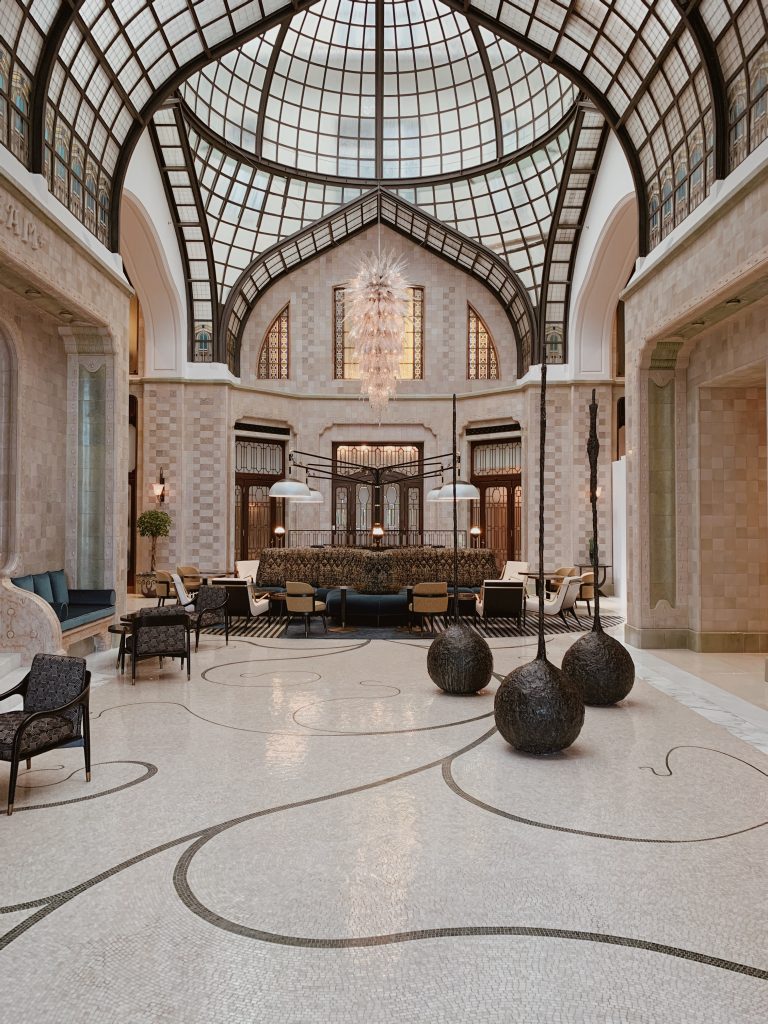
The lobby at Four Seasons Hotel Gresham Palace Budapest was imagined by Richmond Intl., and features this often photographed chandelier.

Long ago, the entrance of Four Seasons Hotel Gresham Palace Budapest included a horse-and-carriage drop-off. During renovations, the design team, led by Richmond Intl., enclosed the drop-off in a labour of love to expand the lobby.

Now, guests can spend the afternoon sipping craft cocktails and savouring an exciting blend of Asian and Hungarian cuisines at MÚZSA, the Hotel’s newest lounge. A raised piano platform adds a touch of theatre in the bar area, in contrast to the more intimate lobby.

Meeting rooms that drive productivity


A conference room in the Four Seasons Hotel Seoul

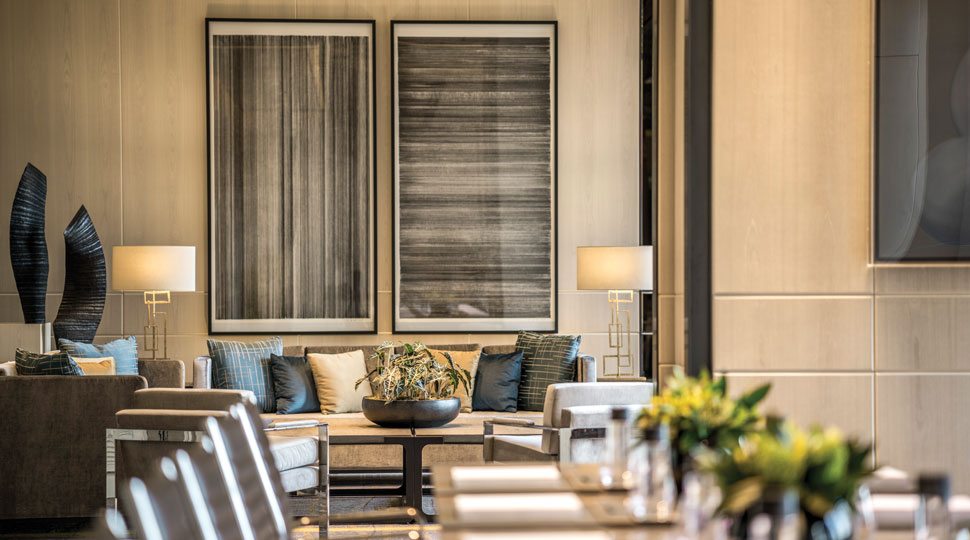
Designed by LTW Designworks, the meeting spaces at Four Seasons Hotel Seoul channel the prestige of Four Seasons coupled with a sense of place.

Given the purpose of a meeting room, it’s important that the design motivates and invigorates. At Four Seasons Hotel Seoul, LTW Designworks followed through.

The meeting and event spaces are designed to encourage productivity and pleasure; the cosy sitting area and plush sofas evoke a residential feeling.

“Korean architecture is always conscious of the delicate relationship between a place and its environment, and strives for a harmonious interplay,” says Su Seam Teo, an LTW partner.

Your Journey Begins Here

What incredible space will you discover next?

Everything You Should Know About Port Wine

As I sit down to write this column I have at my elbow a highball glass of ice, dry white port and tonic.

What, you might ask, is this travesty? Port is red, surely? Port is a sweet, old-fashioned after-dinner drink – not a refreshing aperitif. And besides, who ever heard of mixing it with tonic?

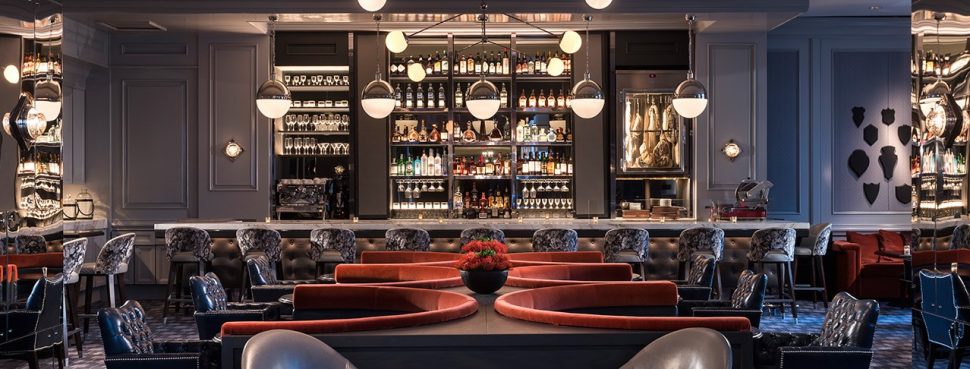
Well, Licínio Pedro Carnaz, for one. Carnaz is the sommelier at Four Seasons Hotel Ritz, Lisbon, and this white port concoction is one of the offerings at the Hotel’s Ritz Bar.

“It’s not well known,” he says, “but [it’s] one of our suggestions as an aperitif, and our guests get very surprised at it.”

The drinking of after-dinner port, vintage port, has been a ritual of the English cultured classes for centuries. In these less formal times, though, it’s a tradition that’s quickly evolving.

Millenials don’t have as many preconceived notions about port, so much more is possible. – James Tidwell, master sommelier at Four Seasons Dallas

“Today, the interest in port may not be the traditional ‘We’re going to open a 20-year-old vintage port,’ but [instead], in using port in different ways,” notes James Tidwell, Beverage Manager and Master Sommelier at Four Seasons Resort and Club Dallas at Las Colinas.

“If you’re talking to millennials about a wine that needs 20 years to be at its best, then you’ve lost them. Millennials are drinking it in any way that’s attractive and affordable.”


White Port and Tonic cocktail at Four Seasons Resort and Club Dallas at Las Colinas

This White Port and Tonic is a modern twist on the traditional wine and is popular among guests at Four Seasons Resort and Club Dallas at Las Colinas.

“But we do have a number of guests who are well-travelled and know wines from all over the world, and they tend to drink 10- and 20-year-old tawnies,” Tidwell continues. (Tawny port is long aged but in wood rather than the bottle, and has a nutty, mellow character.) “And baby boomers are drinking port in the more traditional styles – tawnies and LBVs [late bottled vintage, aged four to six years in wood] – after dinner and with desserts.”

Four Seasons Resort and Club Dallas at Las Colinas

A port primer


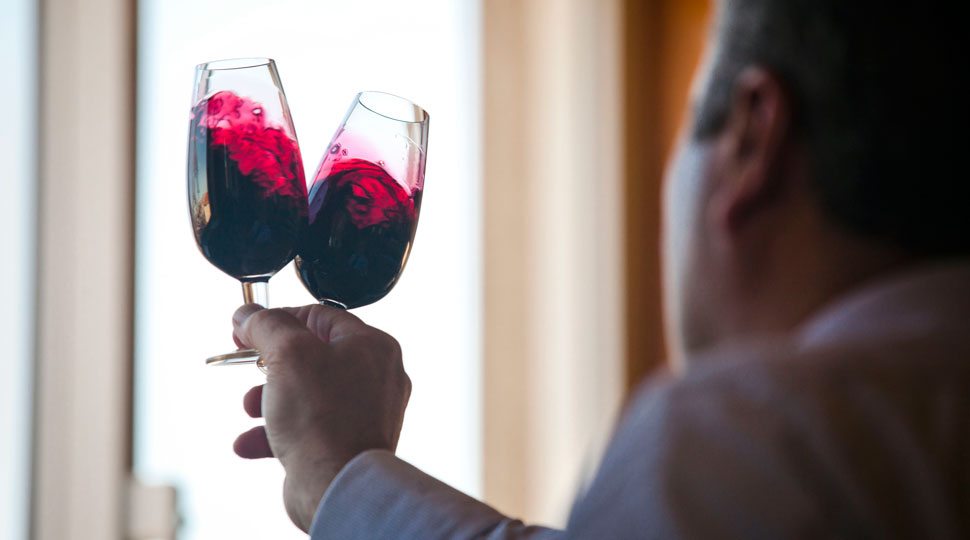
Man swirling port at Graham's Port winery

Port wine’s popularity through the centuries can be attributed to its flavour, which is both stronger and sweeter than traditional table wine.

Port’s longstanding popularity as an after-dinner drink can be credited to its fortification: About halfway through the fermentation process, a dose of a neutral grape spirit known as aguardiente is added to the wine, both fortifying it and halting the fermentation before all the sugar has been converted to alcohol. The resulting wine is both stronger and sweeter than traditional table wine, and comes in several varietals:

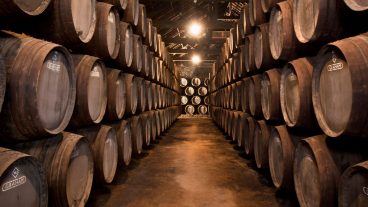
  • Vintage port is made in tiny quantities in only the best years and bottled after two years in 550-litre (145-gallon) traditional oak barrels called “pipes.” It then ages for 20, 30, even 50 years.
  • Crusted port is a blend of different vintages, bottled young enough so it throws a sediment, like vintage port.
  • Tawny port, long aged but in wood rather than the bottle, has a nutty, mellow character.
  • Late bottled vintage (LBV) port, a single-vintage port bottled after four to six years in wood, offers some of the character of vintage port at a more modest price.
  • Ruby port, a blend of young vintages, is fresh and fruity but lacks the complexity of older versions.
  • White port is similar to ruby but is made from white grapes. It is best chilled, as an aperitif.

Preserving port history

Port has been produced since the late 17th century, and became popular in England when constant wars with the French cut off access to Bordeaux. The continuing English influence can be seen today in the prominence of brands such as Graham’s, Taylors, Churchill’s, Cockburn’s and Croft, all named for English founders, many dating back to the early 18th century. Members of the Taylor, Churchill and Graham families are still involved in the business today.

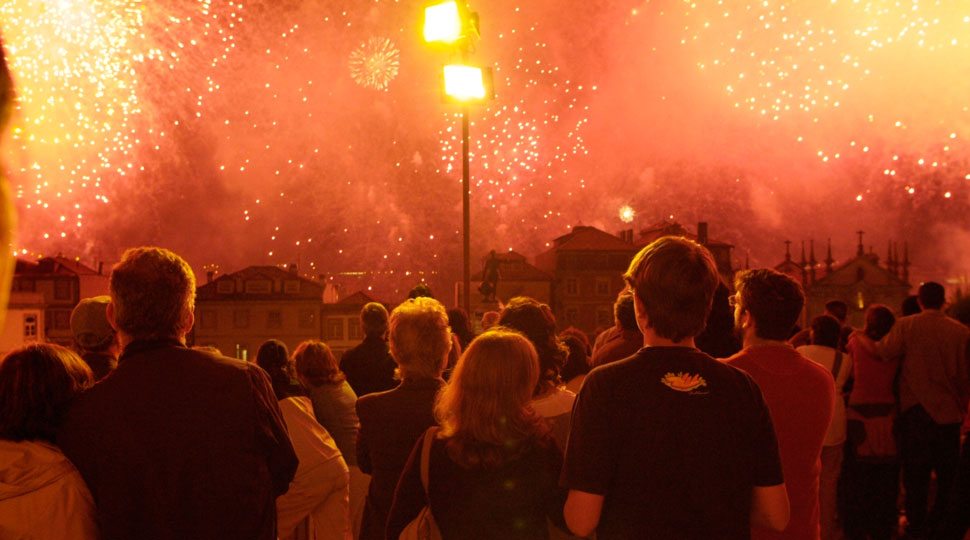
Many of these houses participate in an annual sailing race in the sleepy Portuguese town of Oporto (a three-hour drive from Four Seasons Lisbon) during the annual festival of São João (St John). The unusual barcos rabelos, emblazoned with their company names and logos, race upstream along the Duoro River – a nod to the route these boats once took to deliver the wine from the vineyards to the port lodges in Vila Nova de Gaia. With a flat bottom, no keel, and a long and heavy oar, these unwieldy boats are extremely difficult to control under sail.

“They were never designed as sailing boats, but we, in our infinite wisdom, use them as such, and as a consequence we sometimes have spectacular accidents,” says Dominic Symington of Symington Family Estates.

Four Seasons Hotel Ritz Lisbon

Evolving tastes

A century ago, English aristocrats may have imbibed only the best vintage port, but times have changed. Most in demand now, Tidwell says, are port coolers, chilled tawnies as aperitifs, and anything that’s experiential and accessible.

“Can people afford to drink mature vintage port on a daily basis? No. Can they go into a wine bar in Brooklyn and get a white port cooler? Yes. They can afford it, and it’s something they can understand.”

Adrian Bridge, CEO of The Fladgate Partnership, makers of Taylor’s, Croft, Fonseca and Delaforce brands, is seeing the same trend. “In the U.S., it’s the rapid growth in cocktails and punches, in on- and off-trade respectively, that has created the most excitement recently,” he says. “Barmen and mixologists are finding that port has a range of wonderful flavours that can be used in a number of cocktails.”

As drinking patterns change, port’s versatility and adaptability have become its strengths.

While he doesn’t sell much vintage port – the market for this rarity has always been Great Britain – Carnaz at Four Seasons Lisbon says the demand for tawnies and LBVs, in addition to remixes like the white port aperitif, remains steady: “We sell more LBVs because they are easier to drink, they are filtered [so there’s no sediment to worry about], they’re not so expensive, and they keep in good condition for a few days.”

Carnaz has observed another development in port drinking, one that would have shocked the practitioners of the old procedures. Now that Chinese people have discovered port – not surprising, he says, given their predilection for sweeter alcoholic drinks – “they like it especially with the Portuguese seafood dish arroz de marisco. It’s a very strange combination, but they love it.”

Your Journey Begins Here

Make sure your port tasting tour includes traditional varieties and new adaptations.

property-feature-image-LIS

A Michelin-Starred Chef Stirs Up Soupe à l’Oignon

I’m at Four Seasons Hotel George V in Paris, following my guide through the sumptuous gallery lined with regal Flemish tapestries. As I watch guests leisurely enjoy a late breakfast, suddenly he taps a hidden button on the floor, and we slip behind the wall into the labyrinthine kitchens of Le Cinq. The Hotel’s fine dining restaurant has just been awarded three Michelin stars for the second consecutive year, while the Mediterranean menu at Le George and the Hotel’s newest dining addition, L’Orangerie, each recieved their first Michelin star this year.

For me, to succeed in making a humble local product luxurious is the role of haute cuisine today. – Chef Christian Le Squer

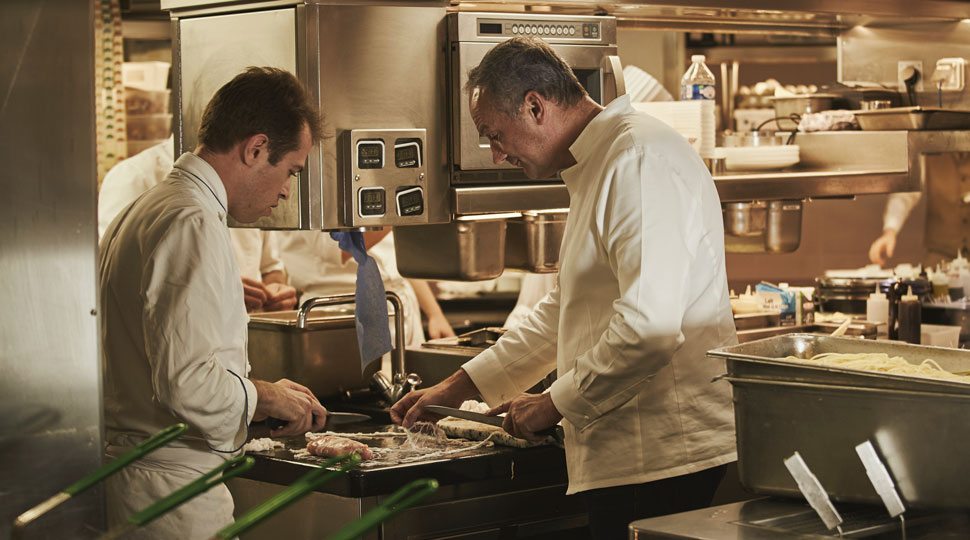
We navigate around hot plates, sizzling pans and trays of freshly baked croissants to find Le Cinq’s Executive Chef Christian Le Squer in his whites, supervising the meticulous preparation of one of his signature dishes, a soupe à l’oignon. The classic French soup he serves, like many of the Hotel’s deft details, is quintessentially French, yet unique.

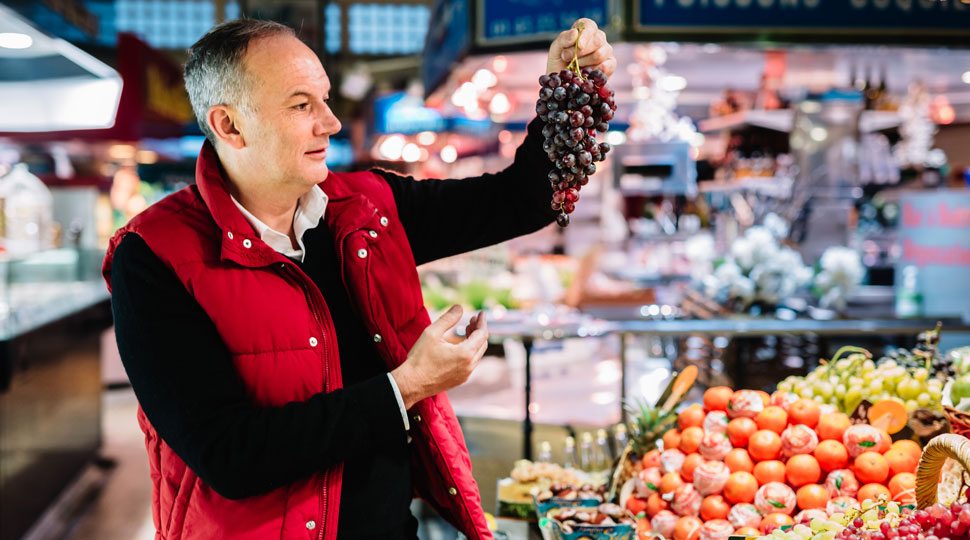
Originally from Brittany, Le Squer maintains a strong connection to slow-life values – he still cycles to work most mornings – and sustainability is important to him. To ensure the quality of the dishes, Le Squer and his team constantly seek out the best produce.

“We usually order from the best farmers, usually from people who specialize in one product,” he says. “For instance, for the onion soup, the onions come from one place in summer, and at this time of year they come from another, from the Cévennes [in south-central France], because they have a certain sweetness to them that I like.”

Four Seasons Hotel George V, Paris

Earning Michelin stardom

For more than 10 years, Le Squer was at Pavillon Ledoyen, another Parisian institution, where his cuisine earned him three Michelin stars. When he arrived at Four Seasons Hotel George V, Paris, in 2014, the chef’s challenge was to retrieve a third Michelin star for Le Cinq. By February 2017, he’d succeeded in doing so twice. And it’s easy to see why.

I’m just like a perfumer. Inside my head it’s like a library of scents, but for flavours. I remember flavours and I know which ones I’d like to put together. – Chef Christian Le Squer

The extravagant, colonnaded Louis XV and Louis XVI surroundings certainly help, as does the stellar service, but the jewel in the crown is Le Squer’s cuisine, which plays on refined simplicity and a dedication to marrying unusual flavours.

“What drives me is my insatiable passion for movement, for evolution, for finding surprising new combinations,” he says. He vividly recalls one such surprise, a match made between oysters and foie gras that he tasted in Japan: “The iodic taste of the oyster cut through the bold fatty taste of the foie gras. It was wonderful.”

A modern twist on a classic


Chef Le Squer's onion soup

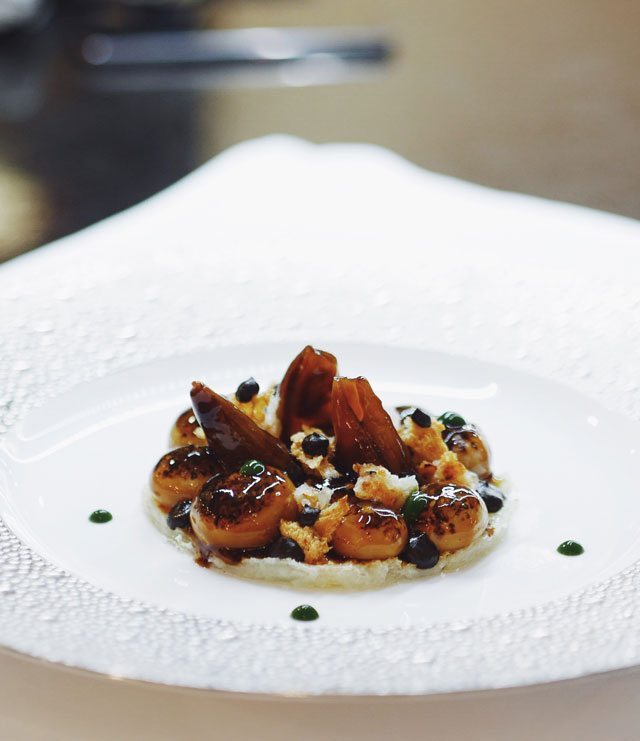
This French onion soup, a classic reinvented by Chef Le Squer, is served on a plate opposed to in a bowl. It’s one of the signature items at the three-Michelin-star Le Cinq restaurant.

While Le Squer’s creative cuisine can be adventurous and doused in plenty of Breton spirit – he particularly likes seafood and fish – his signature dish remains the modest onion soup. “I wanted to reintroduce this old traditional bistro dish,” says the chef of soupe à l’oignon. “However, we’ve completely redesigned it, like Yves Saint Laurent, who redefined how women dressed with his trouser suit. For instance, we serve it on a plate as opposed to in a bowl.”

When the dish is placed before me, I hesitate to spoil the presentation – small, bulbous sweet onions arranged like flower petals on a fine Parmesan galette, dotted with confit onion beads and finished with a dash of truffle and thyme coulis. But I do, and every mouthful is a burst of flavour with all the gourmand comfort of a home-cooked soup.

“It’s precisely that emotion that flavours create that I love. To share that emotion with people is incredible,” Le Squer beams. “You know, it’s important to remember that eating doesn’t belong just to the luxury world. Wherever you cook, the most important thing is always to bring flavour – and therefore emotion.”

Your Journey Begins Here

Taste this soupe à l’oignon for yourself.

Explore

10 Buildings That Define the City of London

Why are 10 million visitors from around the world drawn each year to the City of London? The compact area around Four Seasons Hotel London at Tower Bridge offers unmatched access to the past, present and future of England.

Over two millennia, innumerable important buildings were erected that tell the evolving, three-dimensional story of London.

The City of London is London in miniature, but also on its grandest scale. Within the streets and alleyways of the Square Mile, as it’s often called, lie many of London’s most intriguing and historic buildings.

The City today encompasses much the same area and shape as the city the Romans founded after their conquest of Britain in AD 43. The River Thames – wider and shallower then – was narrow enough here to bridge, but deep enough to allow ships to come and go from the coast, making it the perfect spot for a trading post. Londinium, as the Roman city was named, rose along the river’s northern banks; it was a commercial and connected city from day one.

Over two millennia, innumerable important buildings were erected: public spaces, places of worship, grand private houses, banks, offices. Here are 10 of the best, whose stones – and glass and steel – tell the evolving, three-dimensional story of London.

Roman Amphitheatre | AD 70

Where it began


Old outline of a Roman ampitheater

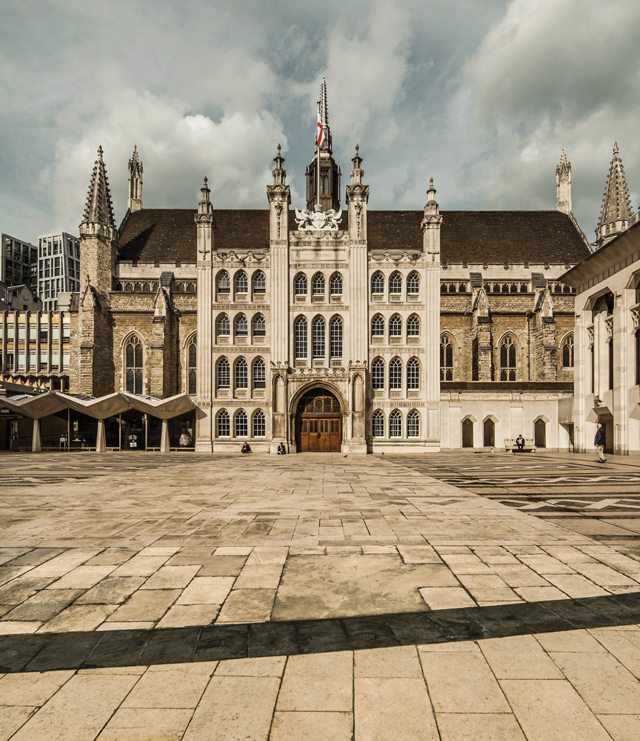
Guildhall Yard was built on the site of the Roman city’s amphitheatre. Today, a subterranean display gives an evocative impression of the amphitheatre’s scale, and its outlines are traced above ground in the paving of Guildhall Yard. 

The City of London stands directly above the site of Londinium, and many Roman structures have been unearthed – some more recently than others. The site of the city’s amphitheatre was unknown until 1988, when excavations for the new Guildhall Art Gallery uncovered two sections of curved stone wall, 6 metres below Guildhall Yard. Investigation revealed that the amphitheatre was originally built in AD 70, and that it was extended in the second century to seat around 6,000 spectators, who would have watched gladiatorial contests and other public events there.

Tower of London | 1100

Power and might


Tower of London

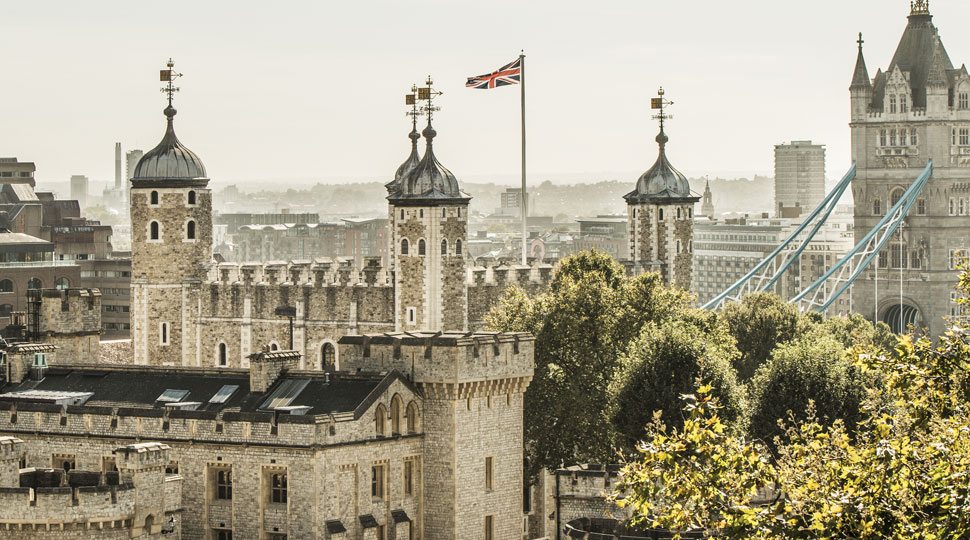
Begun in 1066 and completed in 1100, the Tower of London served as an assertion of Norman might and protection over the city.

After the Romans retreated in the early 400s, the City seems to have been largely abandoned. Though King Alfred initiated repair of the Roman walls in 886, it wasn’t until Britain was conquered by the Normans in 1066 that the City regained its importance, signified by the construction of the central castle keep of the tower of London.

A royal residence and military stronghold, the keep is still the heart of the Tower of London. And though much of it was restored in the 1800s, the chapel of St John on the first floor remains the finest example in the country of Anglo-Norman architecture at its purest and most powerful.

St Bartholomew the Great | 1123

Divine inspiration


St Bartholomew the Great

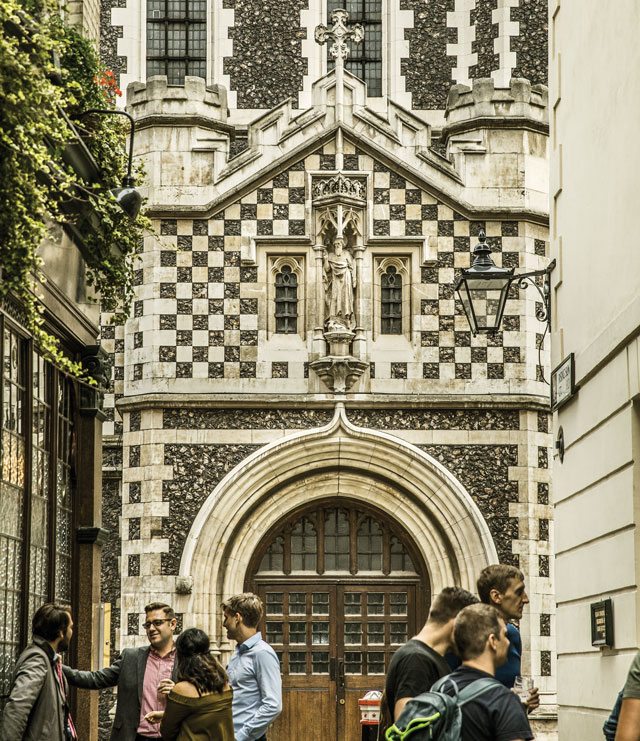
St Bartholomew the Great is all that is left of the much larger 12th-century church.

The City today may be synonymous with banks, but in the Middle Ages it was dominated by religious institutions, such as the Augustinian priory and hospital of St Bartholomew. The hospital, known simply as Barts, was founded in 1123 by one of King Henry I’s courtiers and still exists on its original site.

Across the road, St Bartholomew the Great is all that remains of a once much larger church. Its interior – which you may recognize from the film Four Weddings and a Funeral – is wonderfully atmospheric, with its original Norman arches and internal oriel window. The five pre-Reformation bells in the tower are still rung for some Sunday services – London’s oldest man-made sounds.

The Monument | 1677

Tragedy and renewal


The Monument in London

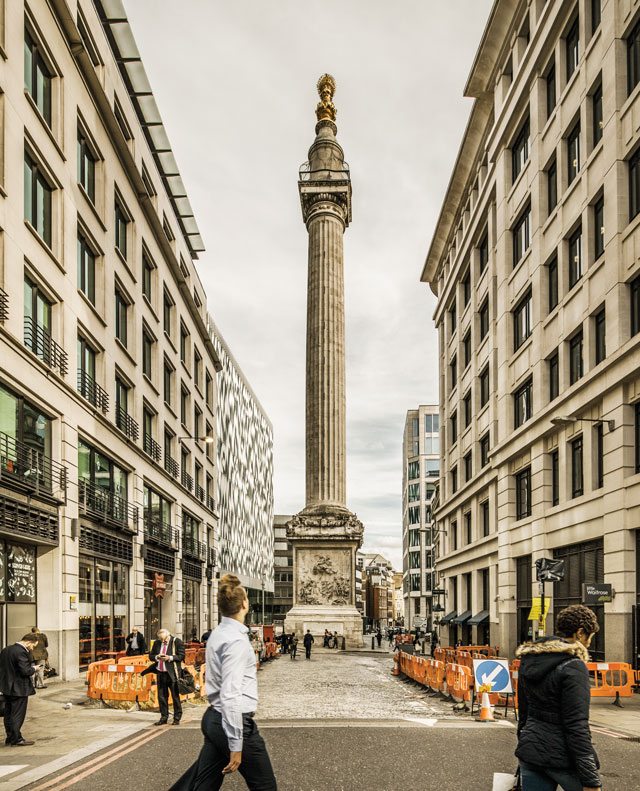
At the summit of the Monument, which commemorates the Great Fire of London, sits a gilded sculpture of a flaming urn.

The Great Fire of London in 1666 was the largest single catastrophe in the City’s history, but out of the ruins rose many of its finest buildings. Chief among these are the churches rebuilt under the direction of Sir Christopher Wren, who designed St Paul’s Cathedral and the Monument, the 62-metre fluted Doric column that commemorates the Great Fire. Metres from where the conflagration began, it is built of creamy white Portland stone and contains an open spiral staircase with 311 steps that lead to a viewing platform.

Drapers’ Hall | 1772

Economy and social structure


Exterior of Drapers’ Hall in London

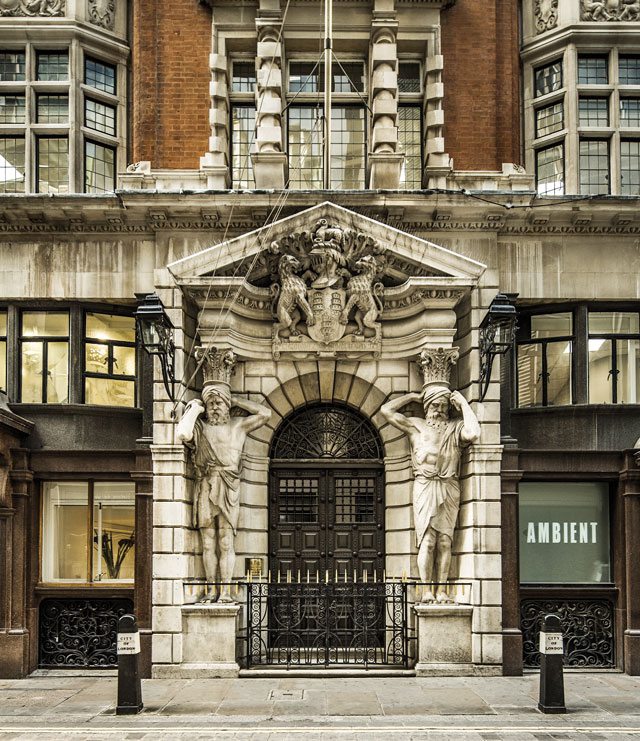
Drapers’ Hall is unusual in standing on its own private, gated road, Throgmorton Avenue, built in the 1870s and complete with a quiet garden.

London’s medieval professions were organized into guilds. Though their original trade-union purposes generally have been superseded, a surprising number of guilds have survived, and their guildhalls are among the City’s most rewarding secrets. The Drapers’ Company bought the site of its present hall from Henry VIII in 1543 but rebuilt in 1667 after the Great Fire – though that work has been hidden behind later Georgian- and Victorian-era alterations.

Leadenhall Market | 1881

Public life and commerce


Leadenhall Market in London

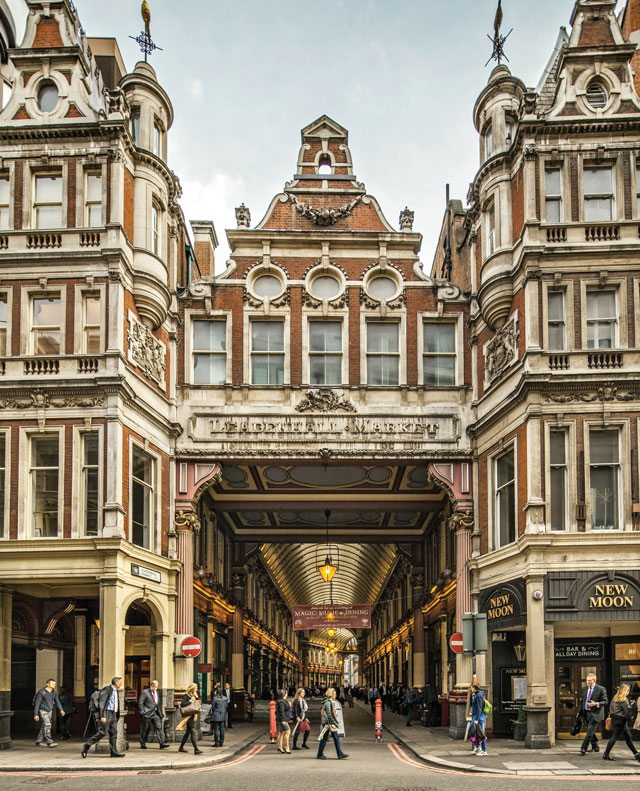
An attractive example of Victorian architecture, Leadenhall Market was designed by Sir Horace Jones, whose most recognized work is Tower Bridge.

Tucked behind the futuristic Lloyd’s building, Leadenhall Market is one of London’s most attractive remaining bits of Victoriana. The buildings date from 1881, but there has been a general market on this site since 1445. Leadenhall Market occupies a historic site on the summit of one of the two low hills of Londinium; beneath it lie remains of the Roman forum, including the lower courses of an arch that can be seen in the basement of Nicholson & Griffin’s barbershop on the corner of Gracechurch Street.

Ten Trinity Square | 1922

Connection to the world


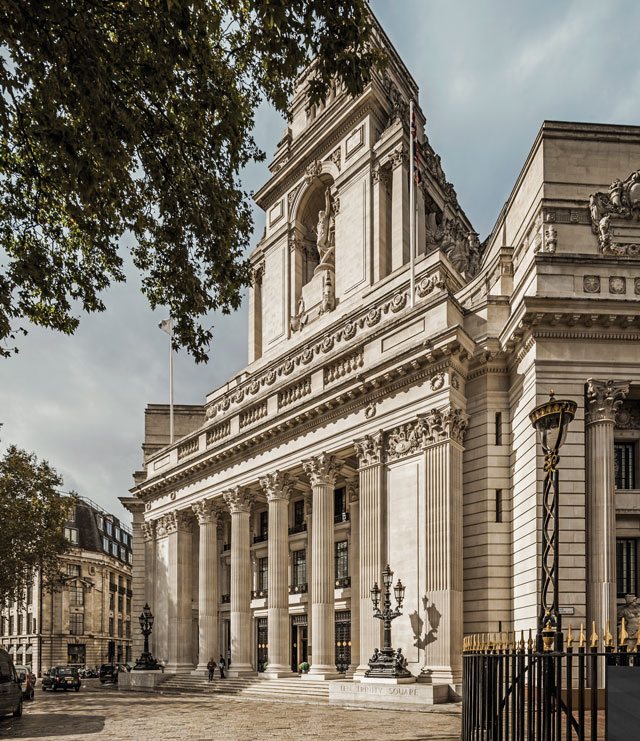
Exterior of Four Seasons Hotel London at Ten Trinity Square

Completed in 1922, the Beaux Arts building that today houses Four Seasons Hotel London at Tower Bridge has been meticulously restored to preserve many design details.

The Port of London Authority was formed in 1909 to run all the docks of London, then the largest seaport in the world, and to be responsible for the River Thames from Teddington to the ocean. Its splendid headquarters – today home to the new Four Seasons Hotel London at Tower Bridge – was designed by Sir Edwin Cooper and built between 1912 and 1922.

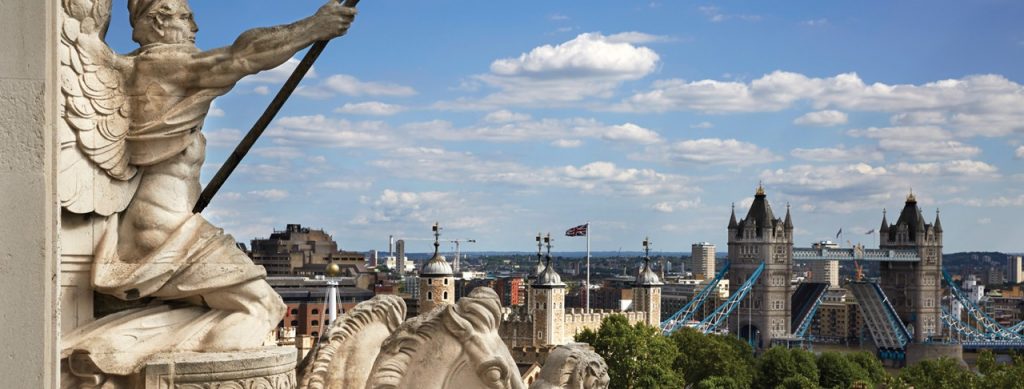
A Grade II* landmark on the Statutory List of Buildings of Special Architectural or Historic Interest, the building’s great tower features a statue of Old Father Thames, who points downriver to the source of London’s trade. The reception of the first general assembly of the United Nations, held in 1946, was hosted here in what is now known as the UN Ballroom, and was attended by (among others) King Faisal of Saudi Arabia and U.S. first lady Eleanor Roosevelt.

Four Seasons Hotel London at Tower Bridge

The Barbican | 1969

Rubble and reinvention


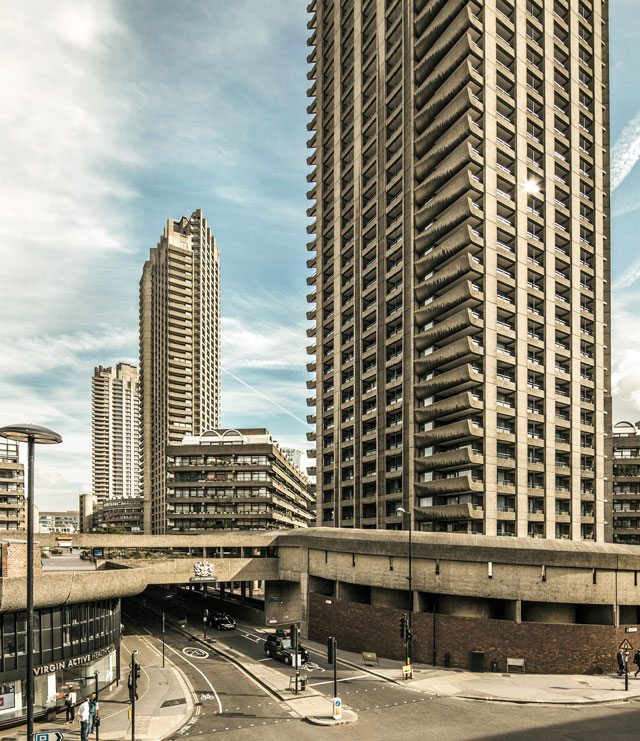
The Barbican in London

The Barbican’s Brutalist concrete style divided critics even before the complex’s completion in 1969.

December 29, 1940, was one of the worst nights of the London Blitz. In 1958, the City Corporation bought 35 acres that had been destroyed that night, and commissioned Chamberlin, Powell and Bon to design a massive complex: more than 2,000 apartments in residential blocks and three 40-storey brutalist-style towers. Though many considered it overbearing, it has acquired fans, as well as a noteworthy performing arts centre – the largest of its kind in Europe – and is now one of London’s most desirable addresses.

The Lloyd’s Building | 1986

Business and innovation


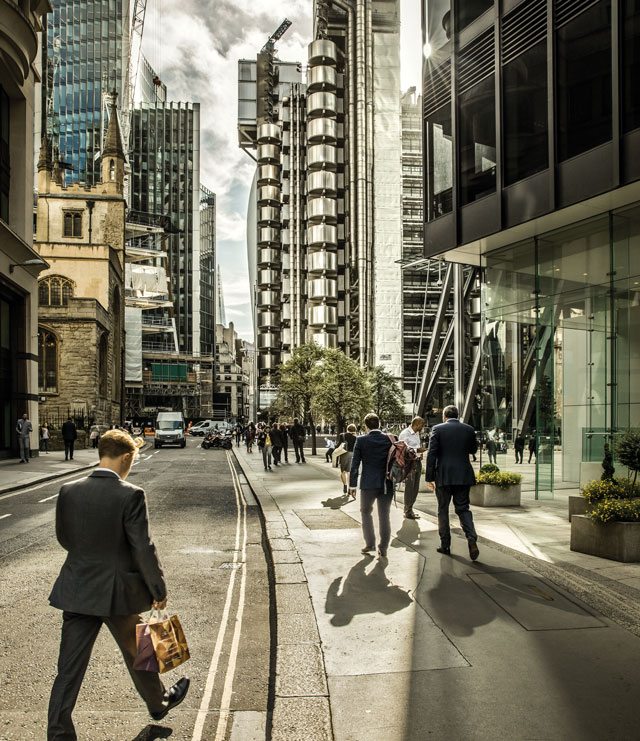
The Lloyd’s Building in London

The Lloyd’s Building features an “inside-out” design, with building services like plumbing and wiring housed on the exterior.

Starting small at Edward Lloyd’s coffee house in the 1680s, London’s maritime insurance market gradually evolved into the giant Lloyd’s of London. In 1986 it moved into its fourth and largest building, designed by architect Richard Rogers using a modular system for future flexibility. This inside-out approach, with a concrete frame clad in glass and stainless steel, was revolutionary. In 2011, it became the youngest building ever to be given Grade I status, putting it on a list of protected monuments that includes St Paul’s Cathedral.

Bloomberg London | 2020

Past and future in harmony


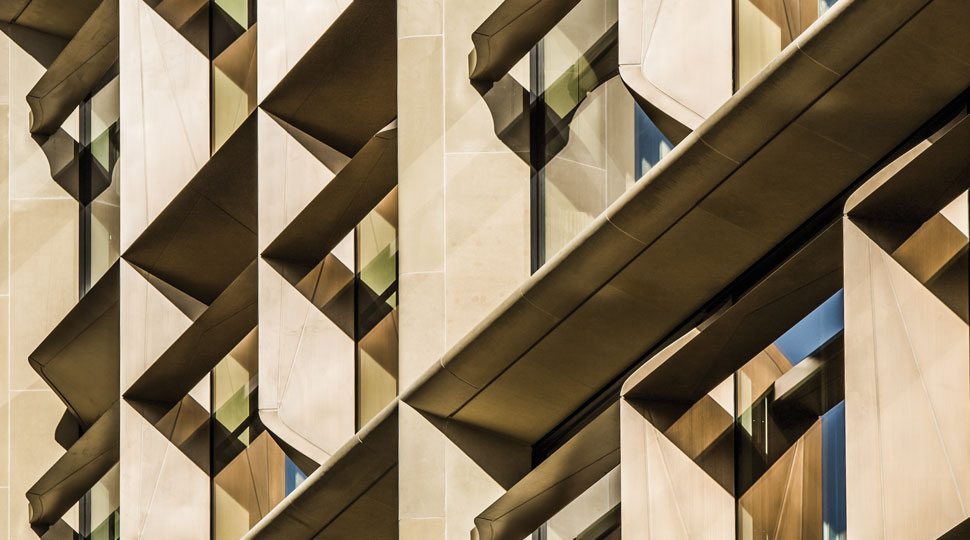
Bloomberg London Architectural Detail

Bloomberg London’s exterior is defined by English sandstone and polished bronze fins, which shade the windows and channel fresh air inside.

Michael Bloomberg’s European headquarters, begun in 2010 and set to open by 2020, will have 4,600 desk spaces and cover 3.2 acres. Designed by Sir Norman Foster + Partners, two 10-storey blocks are separated by an internal street that follows the line of a Roman road. The massive structure is supported by thousands of piles and clad in English sandstone and innovative polished bronze fins.

Underneath lie the remains of a Roman temple, circa AD 240, to be reconstructed in the basement on its original site, putting one of London’s oldest buildings inside one of its newest – and bringing our story almost back to where it began.

YOUR JOURNEY BEGINS HERE

Start planning your historic stroll through the Square Mile.

Statue on building