Travelling China by high-speed train, my young daughter and I were able to experience more of the country in nine days (we travelled from Shanghai to Hangzhou to Beijing) than if we had flown between cities. Not only did we enjoy premium class luxuries and convenience—almost every town in China is connected by the country’s extensive rail system—but views of the surrounding area and cultural interactions within the train gave us a taste of what life is like outside major cities in the Middle Kingdom. China’s trains are praised for their reliability, and we arrived at our destinations on time, almost to the minute.

China has the longest network of high-speed railway in the world, with more than 16,000 kilometres (9,900 miles) of track for trains that can run at more than 200 kilometres (124 miles) an hour.
How to plan a rail journey in China
Our tickets and transportation to and from the train stations were arranged by Four Seasons Concierges before we left home and were conveniently billed to our rooms. Tickets must be purchased within 60 days of departure (58 days if purchased at a station), and it is wise to book in advance—high-speed trains do sell out. However, foreign travellers generally cannot buy tickets remotely, as a Chinese bankcard is necessary unless the purchase is made at a train station in cash, and most booking websites are only in Mandarin.
Which train to choose depends on timetables and preferred class of service. Letters distinguish the various types of trains; C, D and G designate high-speed options. We chose G trains for our journeys because they are the fastest and the only ones with lie-flat business-class seats. Business class is the most luxurious section, with three seats to a row and individual Chinese-language TVs. First-class seats, configured in rows of four, partially recline and are equipped with footrests. Second class has five seats in a row and offers the most basic seating on the train. Regardless of where you sit on a high-speed train, there is a power outlet.

On our nine-day trip through China by rail, we enjoyed the cleaniness and ample light and space of China’s high-speed trains, which rival airlines for comfort and convenience.
High-speed rail from Shanghai to Hangzhou
After a quick security scan at Shanghai Hongqiao Railway Station, I spotted our train number and corresponding boarding area on a huge digital screen. The massive waiting room buzzed with energy as natural light and high ceilings provided a welcome sense of space. Sidetracked by shops and snack stalls lining the perimeter, we forgot to use the VIP lounge (available in some stations) included with our business-class tickets. As queues started to form, a kind man noticed our tickets and pointed to the other side of the waiting room. Each train boards through two gates, labelled “A” and “B,” which are located on opposite sides of the room. Train car number determines which one to queue at, and I had overlooked this detail.
Once on board, I realised that the concierge team at the Hotel had booked us the best seats on the train—first row sight-seeing seats. Sight-seeing seats are located in the first two rows of business class behind each of the train’s two driving coaches, and the windows here are the largest of any coach. The first row also has space at the train’s bulkhead for luggage, which meant that we didn’t have to place anything in the storage compartments between the coaches.
Impressed by comfort that rivals premium classes on some major airlines—our seats even swivelled to face the windows—I relaxed with complimentary bottled water and a snack box for the journey of less than an hour to Hangzhou. The train smoothly stopped at stations along the way, but scenes from the largely undeveloped countryside were blurred when it reached top speeds. Before I knew it, we had reached our destination, and the announcement (in both Mandarin and English) for Hangzhou Railway Station signalled that it was time to gather our luggage and disembark. Staff from Four Seasons Hotel Hangzhou at West Lake were there to receive us in exactly the spot they had indicated by email.
Hangzhou proved to be a gem, highlighted by spring blossoms along West Lake and a private longjing tea-picking tour. My daughter could not get enough of the Hotel’s tranquil gardens and the rustic paths along the lake that we traversed again and again. But after two days, we were back in our sight-seeing seats (booked by the Hangzhou concierge team) and headed for Beijing.
Four Seasons Hotel Hangzhou at West Lake

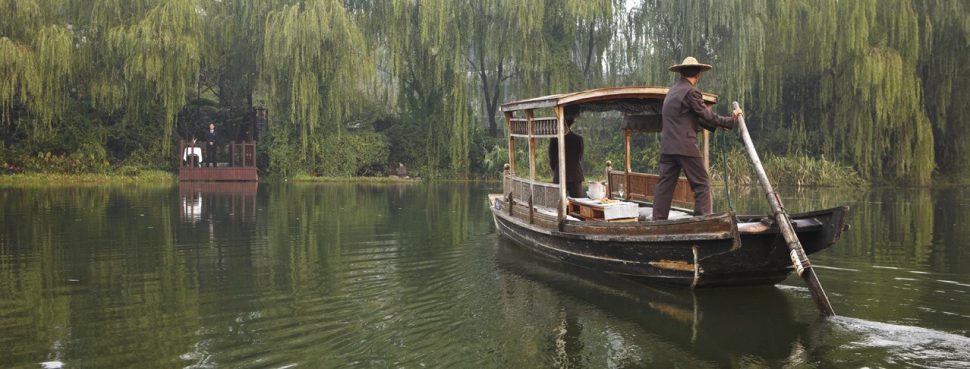
The magnificent West Lake in Hangzhou did not disappoint, with calm waters, beautiful cobblestone walkways and rolling hills in the background.

As part of our two-day tour of Hangzhou, our second stop by high-speed rail, we enjoyed a bit of longjing tea picking in the hills outside the city.
High-speed rail from Hangzhou to Beijing
At just over five hours, our Beijing train journey took almost the same amount of door-to-door travel time as flying would have, but with a few extra benefits. Opting for air-conditioning over a pressurised cabin proved more conducive to our physical well-being. High-speed trains are also affected less by variations in climate and traffic.
With a mother-daughter spa appointment on the books at Four Seasons Hotel Beijing, I wasn’t keen on being late. As it did on the Shanghai to Hangzhou leg, the train sped mostly through rural communities and small cities. To stretch, we walked through almost every coach. Our train was full, but we found an empty table in the dining car and chatted over a soda while others played cards to pass the time. Dining cars sell pre-packaged food, snacks and beverages, and snack carts are periodically ushered through every coach. However, most passengers bring their own food. In case the dining car or meal included with our business class seats (first-class seats receive a meal on long journeys, too) didn’t appeal to my daughter, I had pre-ordered in-room dining from the Hotel, and our lunch order was beautifully packaged for easy transport.
At Beijing South Railway Station, Four Seasons Hotel Beijing staff greeted us at our platform exit and escorted us to the hotel car. We were particularly grateful for this service after seeing the station’s enormous size. Beijing blessed us with blue skies over the Great Wall at Mutianyu, an easy visit to Tiananmen Square, and a Chaoyang acrobat show that finished with a meet-and-greet, arranged by the Hotel, after the performance.
Four Seasons Hotel Beijing

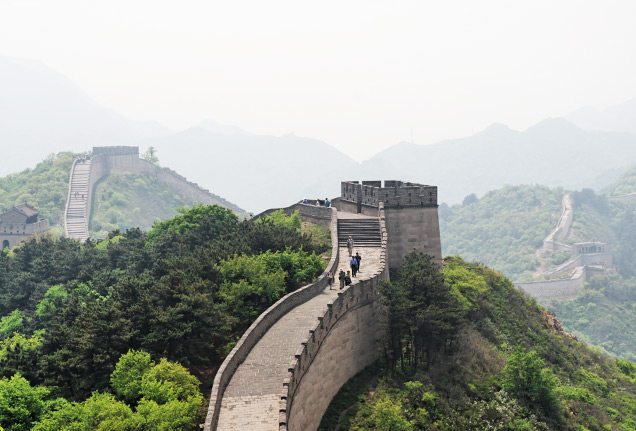
In Beijing, our third stop, we toured the Great Wall at Mutianyu, an excellent place to enjoy China’s most famous landmark.

A tour of Tiananmen Square while in Beijing gave us a look at modern architecture across from the ancient Forbidden City entrance.

We also took in a Chaoyang acrobatic show, and the staff at Four Seasons Hotel Beijing even set up a meet-and-greet with the performers—the perfect end to our journey through China by high-speed train.
I would do it all over again in a heartbeat. And with high-speed trains also running to and from Guangzhou and Shenzhen, and a route to Hong Kong currently under construction, our next train adventure promises to be as gratifying as the first.